By: Michelle Zhen
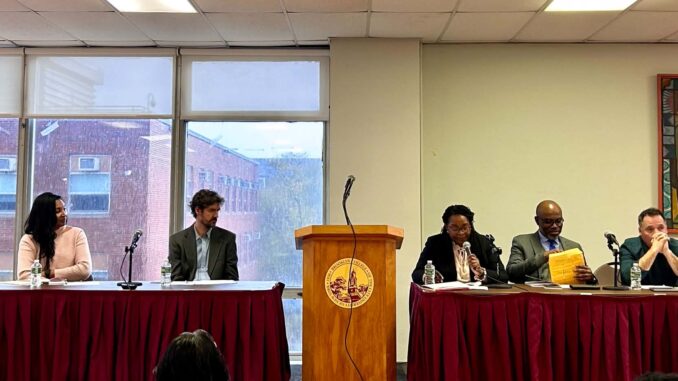
On Nov. 12, in the Jefferson-Williams Room of Brooklyn College (BC)’s Student Center, three BC professors sat alongside two professors based outside New York City: Hyacinth Miller and Gabriel Hetland. These five panelists spoke about their dedication to the Caribbean, its people, and its politics.
“Sovereignty in the Balance: The Caribbean in These Times” reflected the severity of the United States (U.S.)’s foreign policy and its effects on the Caribbean and Latin America. This speaking event is the third of the six-part “Series on The Global Caribbean: Deep Waters, Strong Roots” and the final part of the series for the Fall 2026 semester.
The series is hosted by the Ethyle R. Wolfe Institute in collaboration with the program in Caribbean Studies, and is co-sponsored by Black Faculty and Staff, the Departments of Political Science, Puerto Rican and Latinx Studies (PRLS), and Sociology at Brooklyn College.
“A lot of our students are Caribbean people, or first or second-generation Caribbean immigrants, so the Caribbean is right here with us,” Aleah Ranjitsingh, an assistant professor in the Africana Studies Department and Caribbean Studies Program who helped organize the event series, explained. “The series seeks to publicize the Caribbean Studies program [and] our classes and let people know that […] with Caribbean studies, even minoring or majoring in it, you can get into any number of fields. The Caribbean is right here. The diaspora is right here.”
Ranjitsingh began the event by holding a moment of silence in recognition of the deadly building collapse on Flatbush Ave the day prior. She noted that, of the entire event series, this event’s topic was the very first they wanted to speak on, before presenting a video of Venezuelan political unrest and citing how it has been over 313 days since Nicolás Maduro was captured by the U.S. government. She explained that the U.S. has conducted 41-100 interventions in Latin America, a number that fluctuates depending on how strict or loose one’s definition of “intervention” is.
“I thought [this event would] just focus on the Caribbean, but it also spread to Latin America,” Keanna Benjamin, an administrator of The Wolfe Institute, said. “It was about modern-day things that are happening, […] so it was easy to follow along with, like them talking about the elections in Brazil. I followed that news story.”
Alan A. Aja, chair of PRLS and co-director of the Mellon Transfer Student Research Program at BC, claimed that 56 U.S. military interventions took place in Latin America, many of which enforced the neocolonialism that the U.S. placed upon Latin America, notably Cuba through an embargo. He also emphasized the climate’s importance in politics, as fossil fuels and energy depend heavily on the climate.
Miller, an Assistant Teaching Professor in Rutgers University’s Department of Africana Studies and Political Science at BC, recalled her time in Jamaica, when the country experienced a nationwide power outage. She claimed that the outage coincided with the second New York Knicks game in June, yet the cause was cited as “severe weather and lightning”, to much scrutiny from Jamaicans. Miller looked around the room as she spoke.
“Sound familiar, Puerto Rico?”
Jean Eddy Saint Paul, a Professor of Sociology at BC, focused on Haiti’s historical relationship with the United States. He described the Haitian Revolution and its motto, “liberty or death”, in relation to Thomas Jefferson and John Quincy Adams’s sanctions of Venezuela in Oct. 1804 and U.S. occupation of Haiti between 1915 and 1934.
Hetland, Associate Professor and Director of Graduate Studies at SUNY Albany, said, “Latin America has always been a very important region, especially for the U.S., [which has], unfortunately, often treated [Latin America] as a ‘backyard’, and there’s been a reassertion of interest in the U.S. of the U.S. towards Latin America recently. So I think that having events focused on Latin America and the Caribbean is very important, and so I’m always more than happy to speak at such events.”
Hetland reiterated Aja’s point on climate change and Ranjitsingh’s mention of the ongoing Venezuelan conflict. He showed a photo from the New York Times captioned “Rubio is effectively running Venezuela now” as he noted Delcy Rodríguez’s role as acting president and her relationship with the U.S. as the Venezuelan public grows disillusioned by the force that the U.S.’s current administration exerts on the country for oil companies’ sake.
“The Caribbean, for the past several years, has been under a lot of [stress] as dictated by this current administration,” Miller told the Vanguard. “For example, they are all agreeing to host migrants removed from the U.S. [in] temporary sites before the migrants are sent elsewhere, [but] this is not something that they would normally be comfortable doing.”
The event concluded with final words from all five speakers regarding the future of the Caribbean and the U.S., noting the effects the recent “Blue Wave” may have on foreign policy. In response to a question from the audience, Miller also noted that people from the U.S. exert a lot of control over Caribbean sovereignty, even over Caribbean citizens.
“The [Caribbean] is resilient,” Miller said. “There are a lot of people that [ …] continue to work toward peace, and justice, and sovereignty, and as Black Americans say, ‘trouble don’t last always’, and so many people are working toward a time where they can realize the goal of a sovereign nation.”
For more information on the Wolfe Institute, visit @bc_wolfeinstiute on Instagram or their website: https://www.brooklyn.edu/wolfe/