By: Adam Magwood
On Sept. 23, María del Carmen Abascal, 87, was evicted from her home of 71 years in Madrid, Spain, and carried out on a stretcher by law enforcement. Abascal was expected to be discharged, but no more than 2 weeks later, she passed away in a hospital.
The real estate company that owned her property sought to rent it to another tenant at a higher price, uprooting Abascal from the home she had lived in for decades.
What survives her now is an image of the violence of the housing industry in the country, and an ignition of a political mobilization that has long been brewing. The frustrations felt by many are not only towards the housing market, but also towards the ills of capitalism, and a distrust of leadership.
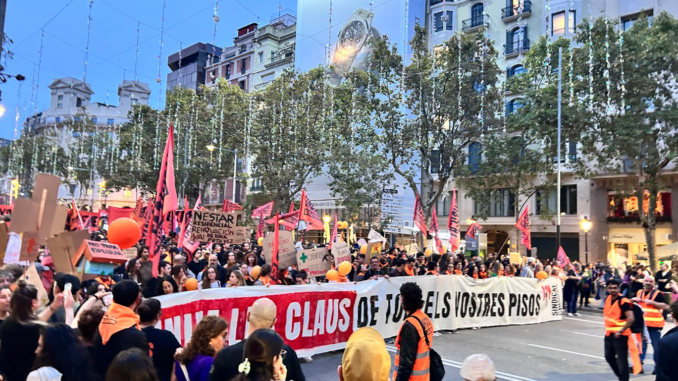
Marches and demonstrations have taken place, from the encampments at Puerta del Sol in Madrid to the mass protests in Barcelona.
Alongside tenant and trade unions in Spain, youth have firmly established themselves in this fight. This collaboration led to a call for a general strike on Nov. 11, ahead of the Nov. 29 snap elections.
The students and youth of Spain have connected the struggles of the housing activists to their own, and student groups like Contracorriente and CRT (The Workers Revolutionary Current) have been leading the charge by organizing education strikes and assemblies that promote class struggle and solidarity in support of the general strike on Nov. 11.
Under the slogan of “Ens Costa La Vida” (“Living costs us our life”), demands include defending housing and public services, and sustainable infrastructure and pay.
Marching in the strike, there was a palpable fury in the voice of the people, but even more palpable was the compassion people had for their peers.
There was music and hopeful chanting, graffiti, fireworks, and noisemakers; there was laughing and embracing, creating a welcoming environment that encouraged unity.
Several people were there attending their first protest; some were experienced protestors, and others were used to being involved in such demonstrations.
The jingling of house keys was a recurring sound as protestors marched, a visual reference to the struggle to afford a home; as more people joined each time, it became clear that what happened to María del Carmen Abascal can happen to anyone.
Various groups filled the streets, from the flags for Spain’s General Union of Workers (UGT), masked graffiti artists who made their way through the crowds to mark the streets, communists flying the hammer and sickle, as well as young children and students.
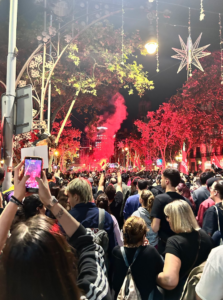
Kids no older than 5 years old were shouting for “La Vaga General” (General Strike), and everywhere you looked was a congregation of students, be it high school or college or graduate students, all who showed up that day to demand a future they feel has been ripped from their grasp.
Around 25% of those arrested in the Barcelona protests on Oct. 24th were minors, demonstrating the fact that the radical political mobilization in not only Spain, but globally, is skewing younger.
Students, who have lived here most of their lives and want to continue doing so while studying, told me that they “dream of buying a house,” though it is unlikely because of the current conditions of the market, and “people aged 22-25 are now staying at home with their parents instead of living on their own.”
The University of Barcelona was a few blocks from the main street where the demonstration was happening, and it was a gathering place for many.
Students were walking out of the building with their flags ready, emergency aid groups prepared for the strike on the entrance steps. A huge banner hung from the building that read “11N – VAGA GENERAL.” This was the first general strike Spain has seen in roughly 14 years, and another student told me that despite the current conditions being fought, she is more hopeful now than ever, and at the strike of 400,000 in Barcelona today, she had a “lot of faith that this will work.”
Natalia Lago, member of student political group Contracorriente, remarks in an interview with “El Tablero” that “we want to do what they did in France.”
France has been in the news as of late for the mass uprisings in its cities and suburbs, stemming from students fed up with the state of their underfunded education system, short staffing, and poor building quality inhibiting their education, and eventually bringing in workers who were fed up with the austerity of the Macron Regime.
India has recently seen its young population rise up as part of the “Cockroach” movement, co-opting a comparison India’s Chief Justice made between student protestors and pests.
Social media shows us in real time what is happening on the ground internationally and allows this political energy to spread like wildfire globally, independent of borders; many whom I spoke to insisted it played a major role in spreading the word and organizing the strike.
The student protests in Belgium and school occupations in Italy show a youth fed up with a system that has failed them, realizing the future they were promised does not exist under it.
Democratic Socialism has seen major wins domestically and received fantastic publicity in New York City, with Mayor Zohran Mamdani.
Young Americans are more sympathetic to socialism as they become disillusioned with capitalism. The second election of President Donald Trump is, to my mind, a great turning point of American politics, as we have since witnessed a huge leftward shift in the population– see the recent blue wave covered by The Vanguard.
However, the fight for a better future is not only at the polls. As Lago states in her interview, channeling discontent cannot be directed solely toward electing candidates “at the service of [capitalists].” The dire housing situation plaguing Spain has happened while the center-left PSOE and SUMAR parties have held power since 2018.
The strike on Nov. 11 shows the power of unity and solidarity, and our ability as young people to disrupt the status quo.
There is certainly a fire that burns for justice at the heart of the student population in the United States.
As the suffocation under a capitalist system becomes increasingly undeniable to us and youth everywhere, what’s preventing us from similar mobilization?