By: Elianna Tsigler
Whenever someone asks how they can become part of the punk, goth, metal, or any alternative music scene, the answer is often the same: It is about more than just listening to the music or dressing the part. These communities have historically been tied to specific values, and to be a part of it, you must align with them.
But what happens when some of the most influential bands within these genres no longer uphold those same principles? What happens if these principles never existed?
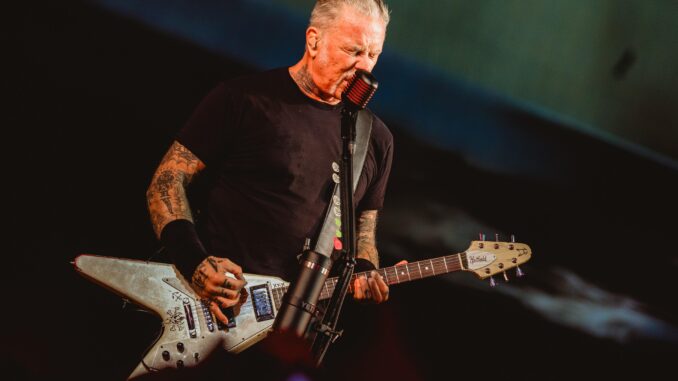
On Oct. 10, during a performance at the Las Vegas Sphere, Metallica frontman James Hetfield stated that “Metallica is not here like some other entertainers to influence you with their bull–.”
The band has been saying this for years; however, to many new fans this comes as a shock—myself included. “I hate politics, I don’t want to talk about politics,” Hetfield shared with La Tercera back in 2017.
As someone hearing this for the first time, it’s quite bewildering to hear this contradicting apolitical stance when, as a longstanding fan, you can’t escape the political messages in Metallica’s music.
In an interview with Rolling Stone, Hetfield spoke about the meaning behind one of their songs, “Ride the Lightning.” He stated that “We just got into some social topics. The death penalty was a big question and the electric chair […] That’s what that song was about, being accidentally found guilty and put to death with no way to stop it.”
“Ride the Lightning’s” lyrics portray criticism about the government: “Who made you, god, to say ‘I’ll take your life from you?’” This is a rather common argument opposing the death penalty as well, which can be seen in an article by Amnesty International—a group that campaigns against the death penalty—where it states that “All too often, it’s [the death penalty] used as a weapon of state control – designed to expand authorities’ unchecked powers and punish dissent.”
Similar things can be said for “…And Justice for All”. Some of the songs on this album, such as the title track, “The Shortest Straw,” “Blackened,” “One,” and “Eye of the Beholder,” all hold political meanings.
Hetfield also said in a 2018 interview conducted by So What! magazine that “‘The Shortest Straw’ for sure is more political than any of the other songs. I mean, it talks about a time, McCarthyism and the artist not being able to be free, but also [when] communism is a problem.” He also affirms that “‘One’ is an anti-war song.”
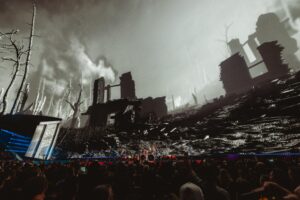
During live performances, these messages are reinforced—especially for “One”— through visuals depicting war and destruction. But, despite all of this, in 1992 Hetfield said that “I mean we’re not anti-war, we’re not pro-war.”
Fan reactions have been split. Some have expressed support, arguing that politics have no place in music or that they don’t matter. Meanwhile, others question the significance of the albums mentioned, such as “…And Justice for All,” if they weren’t supposed to be political.
The discussion grew further when Sharon Osbourne—the wife of former Black Sabbath frontman and arguably the most influential figure in metal, Ozzy Osbourne—publicly supported Hetfield’s statement.

While it may come as a shock, it is something that has apparently been said for decades. In a 1970 interview with New Musical Express, Osbourne said that while Black Sabbath’s song “War Pigs” carried a message, the band itself was not political: “We’re not a political group, it’s just that most of our songs have messages.”
It appears that when politics are mentioned outside of their music, it is an issue, and the band no longer has a stance on what their music advocates for. Although people can interpret lyrics in many ways, some meanings are simply undeniable, especially when reaffirmed by the artist themselves.
As a member of the metal community, I can confirm that it is much like a family. The community itself spans multiple generations of fans. We are all there for one specific reason: to enjoy the music. But we enjoy the music not only for how it sounds, but also for how it resonates with us and the messages it conveys.
Heavy metal has always had political roots. It began specifically with the Vietnam War, and “since metal has had a rich history of influencing the anti-war counterculture movement.”
There have been three major phases in metal: “(1) The 70s-80s anti-war rhetoric, (2) the 70s anti-monarchy movement in Britain, and (3) the modern movement against corporatism in the US,” according to The Sais Observer.
Thrash metal came from heavy metal, emerging in the early 1980s, and kept the political ideology, with messages changing to reflect the issues of their time. Overall, “the world started seeing metal bands as necessary voices.”
This is why the issue has become such a dilemma. A considerable portion of the community has been built around these values, and many bands have incorporated them into their music. While there are plenty of non-political songs throughout the genre’s history, those that carry political or social messages should not be dismissed under the guise of neutrality. Doing so risks overlooking the significance those songs have held for listeners and the role they have played in shaping the community itself.
This is not to say that the legitimacy of the messages or the genre should be in question—as if the pillars are crashing down—or that people should stop being fans, because, regardless of the ideologies the band may hold, the music speaks louder than them.