
By: Renae Visico & Ameena Khan
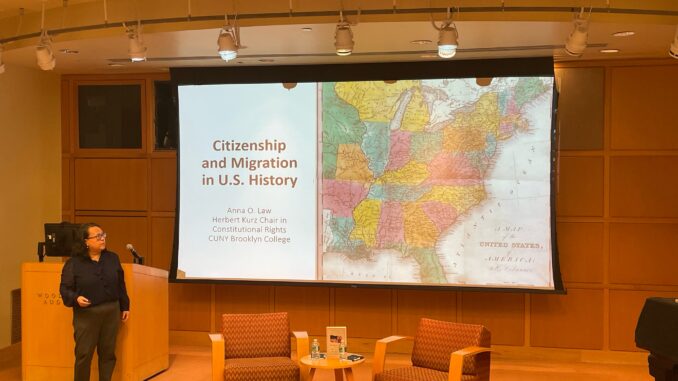
On Nov. 3, the Brooklyn College (BC) Ethyle R. Wolfe Institute for the Humanities presented “Migration, Citizenship, and U.S. Constitution,” a discussion between Professor Anna O. Law, Professor of Political Science and Herbert Hurz Chair in Constitutional Rights, and Professor Prudence Cumberbatch, Associate Professor and Chairperson of the Department of Africana Studies. This discussion was a part of BC’s Solidarity Week 2026 to celebrate the release of Professor Law’s new book, “Migration and the Origins of American Citizenship.”
As attendees gathered in the Woody Tanger Auditorium, the Wolfe Institute shared that the event was purposefully scheduled on Election Day as a reminder that the direction that the United States (US) will charge into is contingent upon constitutional memory, which Law wrote in her book, “[…] has always been profoundly political and continuously contested, perhaps, more than ever.”
Law’s book and lecture focused primarily on the historical patterns of migration to the U.S., but she made sure to emphasize that current immigration and deportation policies were built off of past policies that forcibly removed ethnic minority groups. She described that the lines between state and federal responsibilities in immigration management have always been changing, as the Constitution didn’t have any specific guidelines on power division for that matter.
“In a federal system of government, where power is shared between the national government and the states, where’s the location of the dividing line between national and local and state power?” Law emphasized to the audience.
For a hundred years, state governments mainly held control over local migration patterns, with New York specifically having Castle Garden as a landing depot for European immigrants before Ellis Island was established.
“New York was the only state that chose to create institutions and laws to protect migrants and not just to restrict them,” said Law.
However, not all of these states offered the same amount of protection to immigrants. States in the South prohibited specific ethnic groups from migrating, replicating New York laws regarding immigration. Slave states kept poor and disabled migrants out by labeling free black sailors as dangerous, as they had the potential to influence slaves that they, too, could be free.
”These are free black men,” Law emphasized. “They’re being sold into slavery because the slave states are saying that under police powers, in Massachusetts, and New York, can keep out dangerous migrants, defined with people as carrying infectious diseases, we have equal rights to keep out people who are morally contagious.”
Free black sailors who got off the boat would be arrested, and if their ship captains did not pay a bond in time, these free black men would be sold into slavery, hence restricting freedom of mobility and an example of how citizenship does not guarantee rights.
Prof. Law also highlighted the deeply interconnected relationship between slavery and the forced migration of Native Americans. More specifically, as the price of cotton increased, Southern planters displaced Native Americans from their homes to make room for more cotton fields, in turn making room for more slaves.
“The institution of slavery affects the trajectory on the substance of voluntary migration laws. I am not saying slavery is immigration. Immigration implies consent, of which slavery, there was no consent,” said Law. “Throughout the book, at different parts of U.S. early history, because of the existence of slavery, I can see clear effects on voluntary migration laws about people who are not enslaved people.”
After the Civil War ended, the federal government started taking on a larger role in local immigration. Law gave the example of Chinese immigrants coming into California, and how the Supreme Court invalidated California’s state laws that protected immigrants.
“Basically, California said, ‘Well, if you’re not gonna let us restrict the Chinese, you, federal government, you deal with it. You take over immigration,’” said Law. “Similar thing going on in the Northeast: After the Civil War, the federal courts started striking down state immigration laws that used to be legal.”
Before the 14th Amendment, the U.S. The Constitution did not clearly define citizenship and birthright. African Americans who were born on U.S. soil were excluded from birthright citizenship until 1869. Naturalization, a process in which immigrants obtain U.S. citizenship, was not given to Asian Americans until 1952 and was strictly reserved for free white immigrants in 1868.
Once the 14th Amendment was passed, the Reconstruction Amendments, a series of U.S. federal and constitutional changes after the Civil War, were enacted to protect the citizenship of newly freed African Americans across the North and South. However, Jim Crow laws would be put into place, restricting African Americans’ freedom of mobility.
Prof. Law expressed that, despite authority powers between the federal government and the state continuously being debated, she highlighted how states do not have to use local law enforcement, nor any resources, to help the government enforce these laws.
Furthermore, Law articulated how the Supreme Court’s interpretation of the law is not only reserved for them, but for citizens as well to be reinterpreted and challenged, especially relevant today.
“Native Americans, although they weren’t asked to ratify the Constitution, [nor] weren’t at the Treaty of Paris ending the Revolutionary War, they certainly had ideas about how the Constitution could respect tribal sovereignty. African Americans petitioned the president, all of an express in black newspapers. These are alternative readings of the Constitution that the majority white majority population didn’t take.”
After Law’s lecture, Professor Cumberbatch took the stage to provide commentary on Law’s book and to ask her questions regarding its subject matter. They discussed economic concerns of immigration, the whitewashing of early American narratives, and the specific inspirations behind Law’s book.
“If you had told me at the beginning of this project, this is gonna take 16 years, I would have quit,” Law told the audience. “But there was this nagging sense in my mind where, you know, we are a nation of immigrants, but we are also a nation of enslavement.”
Ultimately, Law hoped that her book and lecture sparked an interest in history among BC students, as policies of the present often mirror those of the past.
“The U.S. Constitution has never been only what the Supreme Court and political elites say it is,” Law said.
“It wasn’t true then, and it’s not true now. The historical stuff is a reminder, we should not default to what the Supreme Court and what the political elites tell us the Constitution means.”
“Migration and the Origins of American Citizenship” can be purchased through Oxford University Press.
To view the rest of the books featured in the Wolf Institute’s New Books by HSS Faculty Series, you can visit https://libguides.brooklyn.cuny.edu/wolfe2026/fallbooksbyhssfaculty
To stay informed about The Wolfe Institute’s upcoming events, follow their Instagram @bcwolfeinstitute.