
By: Raven Santos and Michelle Zhen
On Oct. 4, The Metropolitan Museum of Art (The Met) opened its latest exhibition, “Krasner and Pollock: Past Continuous”, to capture the lives of Lee Krasner and Jackson Pollock, a married couple of late abstract artists.
The two artists met at McMillen Gallery, where Krasner introduced herself to Pollock, and they married three years later in 1945. They moved from Manhattan to Springs, New York under Krasner’s suggestion, and Pollock set up his workplace in a barn on their property. That barn is where Pollock would eventually paint his iconic drip paintings and, with some help from the Central Intelligence Agency (CIA), popularize them.
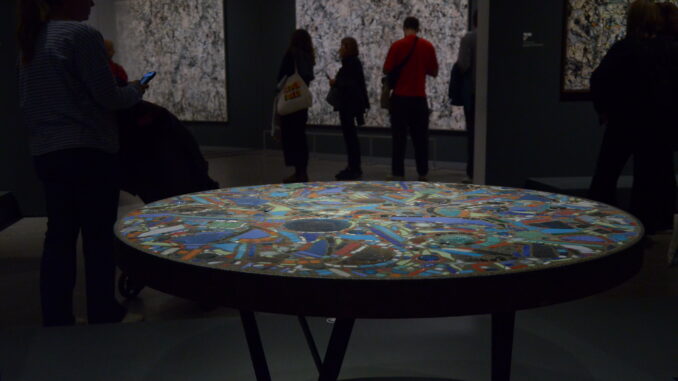
The exhibit features over 120 works from the artists and is the first art exhibit to feature them simultaneously. Alongside Pollock’s drip paintings are Krasner’s works, ranging from traditional sketches during her time as an art student to abstract collages recycling her and Pollock’s old works. A montage with various photos and videos of the couple’s domestic lives is projected onto the entrance wall.
Featured in promotional posters and the exhibit’s complementary art book, Krasner’s “Bald Eagle” opens the exhibit; it consists of warm colors cut into a collage reminiscent of autumn leaves. Beyond the main colors of yellow, orange, beige, and brown, the canvas has undertones of black and pink. One of Pollock’s discarded drip paintings, depicting black streaks and dots over a beige background, was cut up by Krasner and pasted onto this canvas.
“It’s very organic. And I always have been a Pollock fan, but [I am] deeply impressed by Krasner’s work,” said Ray Haynes, a visitor to the exhibit. “I think her work is emergent, but it’s also bounded by patriarchy in some respects. I think within that context of love and their relationship, she emerged from a traditional partner to find her own voice.”
The exhibit also features “Autumn Rhythm: Number 30”, one of Pollock’s most famous drip paintings, halfway through the exhibit. White and black paint race throughout the tan canvas, occupying as much of the space as it can with the thin streaks Pollock allowed them. Dull brown paint hides beneath the stark black and white, but these lines are straighter and wider. Some of the black and white paint gathers more at certain spots, similar to ink blots, adding to the painting’s dynamism.
“I thought, before I came in, that Pollock flicked a bit of paint around and that was it. I enjoyed looking at the big pieces, the scale of them […] it’s interesting and impressive,” Julian Roanoke, another visitor, remarked.
Pollock’s drip paintings, including Autumn Rhythm, are placed front and center in one of the exhibit’s largest rooms. Yet, after his untimely death driving drunk, Krasner dominated the exhibition with her post-Pollock works.
About a year after his death, she moved her art supplies to the barn, and her art became bigger and brighter as her palette gained its colors. She began to paint in umber to represent the wintry cold she felt once her mother died in 1959.
Near the end of the exhibit lies “Past Continuous”, a collage Krasner assembled in 1976 with both her and Pollock’s past works. Many of Krasner’s old works are carefully cut and arranged into what appear to be large monochrome tiles, with the exception of a single, red-orange tile on the right of the piece. As an art student, she mastered her fundamentals, yet she turned to abstract art in adulthood and never turned back until she recycled them for her collages.
“I read that she put aside- well, not put aside [her work as an artist], but […] she was a champion for him. But it’s nice to see her work standing tall here, around the side,” visitor Sue Beck mentioned.
As Roanoke mentioned, abstract art such as Krasner’s and Pollock’s is often questioned as true “art”. This exhibit does not seek to argue that; instead, it uses the abstraction of their works to tell their story, organizing the works into a timeline of their pasts, their meeting, and their futures.
“I like seeing the skill in art, and sometimes it’s hard when it’s so abstract. But seeing the backstory made me appreciate it more,” Brittany McGee, a visitor from California, said.
Pollock became the more popular of the two, which Krasner predicted in her lifetime. Krasner recommended Pollock use the entire barn on their property as a studio, while she worked in a studio office at home.
“She really took it upon herself to campaign for him, and she believed in his genius and wanted him to receive acclaim,” said Caroline Lange, another visitor. “I love that, following his death, she really made her own career. She was working throughout, but she never stopped working.”
Pollock died in 1956 at 44, and Krasner died afterward in 1984. Krasner in particular received more recognition after Pollock’s death, including an Honorary Doctor of Fine Arts from Stony Brook University, but not quite more than Pollock.
The Met’s exhibit will run until Jan. 31, 2027. Until then, anyone who visits the Met may enter the exhibit and see their art — their legacies — for themselves.
Lange continued, “She came into her own, and something I admire is that she allowed her creativity and artistic practice to evolve over the years.”
For more information about this exhibit, visit https://www.metmuseum.org/exhibitions/krasner-and-pollock-past-continuous.