
By: Eddy Prince
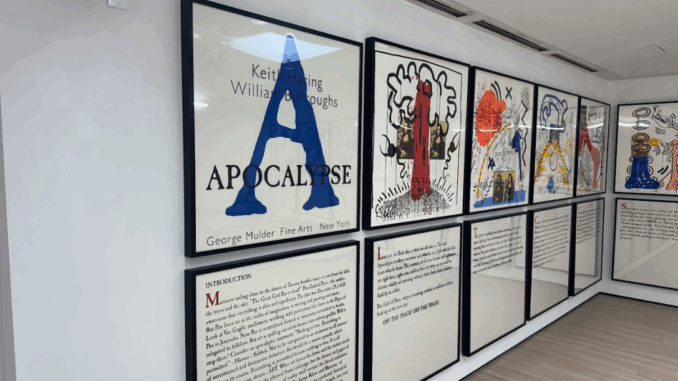
A new exhibit has recently been unveiled at BC, inside Boylan Hall’s art gallery. Students, organizers, and supporters gathered for “Apocalypse”, a 1988 collaboration between famed pop artist Keith Haring and author William S. Burroughs, showcasing some of Haring’s final works. “Apocalypse” is curated by Seung Hee Kim and made possible by the donation of the Leonard-Litz LGBTQ+ Foundation.
“This series is a marriage of art and the written word,” said Elliot Leonard, the founder of the Leonard-Litz Foundation. “It was the context of this art that was very different from his prior work. This was a departure, and it was his [Haring’s] apocalypse.”
“Apocalypse” was created during the height of the AIDS pandemic in the 1980s, and Haring himself was also diagnosed with this illness, which was viewed as fatal at the time. The series of paintings was Haring’s reflection on his own diagnosis, and on death and destruction.
Each painting by Haring was accompanied by a short poem by William S. Burroughs, an influential postmodern author and one of the key figures of the Beat Generation. The Beat Generation comes from the term “Beatniks,” which rejected the mainstream culture of post-World War II, paving the way for the “counterculture” movement of the 1960s and 1970s.
This combination of both Haring’s and Burroughs’ works adds tension and unease to the exhibition, which was felt by the attendees. Much of Burroughs’s poems throughout the exhibit talked about chaos and destruction, alluding to Greek mythology as well as an ancient Islamic secret society of assassins.
“The painter wills his pictures to move off the canvas with a separate life, movement outside of the picture, and one rent in the fabric is all it takes for pandemonium to sluice through,” one of the poems, written by Burroughs, furthers this idea of chaos.
“I think it’s a really accurate representation of calamity,” said Alexandra Ries, a graduate student at BC. “I think that there’s something interesting about the repetition of words and phrases that are in the writing […] It is cool to see text and images together in a collaborative display. I’m a painting major, so it’s interesting to think about writing and making visual art in similar paths and parallel forms. This [exhibit] is a great representation of that.”
“Apocalypse” continues to cycle through university art galleries, nearly 40 years since its creation. Before being displayed at Brooklyn College, the exhibit was showcased at City College in March of this year. BC being the next stop for “Apocalypse” makes a lot of sense, being that Leonard is an alumnus of the school.
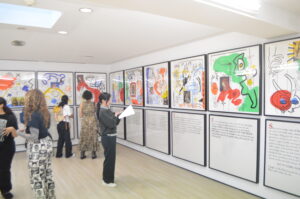
“I think it’s always relevant,” said Ries.“There’s all kinds of shows about the AIDS epidemic that are always up, all the time. Anytime you’re talking about the ostracization of a group of people, or grief in the form of community, it’s pretty impactful. It’s acknowledging the unseen death of millions of people. Especially now.”
While AIDS isn’t as controversial as it was in the 80s, the exhibit still holds importance in the current political and social climate. “The artists who are creating work about that are pretty groundbreaking,” Ries continued. “But now we’re in this [age] of censure, and we’re regressing. So I wouldn’t say it’s groundbreaking in the same way now as it was back then, but it’s still relevant to show the work that was impactful.”
This same sentiment was shared by the Chairperson of Brooklyn College’s Art Department, Mona Hadler.
“There really couldn’t be a better time. This is a really difficult time for our gay community, for our trans community, for AIDS activism,” said Hadler. “It breaks my heart […] I’m really happy to show it.”
With ten paintings followed by ten poems, the collection captures Haring ‘coming to terms’ with his diagnosis. Haring had already seen the public’s fear and stigma surrounding the AIDS crisis, as well as a lack of action politically. Haring set out to express the chaos that had already taken the lives of many people from his community.
“They are free expressions,” said Leonard, who, alongside his husband Roger Litz, also happened to be a personal friend of Haring. “Someone who is dying [two years later] got the energy to create this exhibit.”
Haring continues to be an inspiration to artists everywhere and even inspires the local artists of the BC community.
“Keith Haring is definitely an artist who has inspired me in many ways. Not just through art, but also through entrepreneurship,” said Derrick Adams, an advisory committee member for Brooklyn College’s Art Department. “He understood his cultural production as a ‘commerce’ in a way that is different than most artists […] having a gallery show or a museum show. He looked way beyond that.”
Adams continued, “For us [at Brooklyn College], this exhibition is really important, because we have such a broad range of students from many different cultural backgrounds. We’re interested in everything from street art to museum presentations. So this exhibition serves to complement what our mission is here at the gallery.”
The gallery’s opening reception served as a night of community. Haring had a unique opportunity to give one last piece of himself back to his community through his art. Visitors came together not just to experience “Apocalypse” but to celebrate Haring’s life and his artistry.
“He was a true artist in every sense of the word,” said Leonard. “He’s a truly great artist of the second half of the 20th century […] Keith will go down in history.”
“Apocalypse” will be on display in the Art Gallery in Boylan Hall from September 30 until December 12.