
By: Serena Edwards
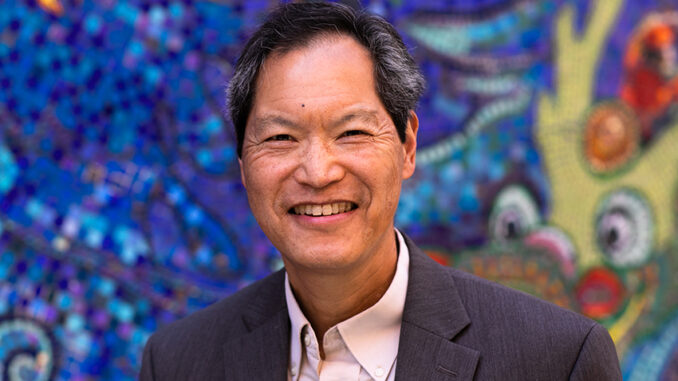
The Ethyle R. Wolfe Institute will host Russell Jeung as the official Hess Scholar-in-Residence for 2026.
The Wolfe Institute annually brings a scholar to Brooklyn College’s (BC) campus for Hess Week as their Hess Scholar-in-Residence. The Scholar-in-Residence program allows experts in all mediums and paths to bring diverse perspectives and topics to the BC campus.
This year’s Hess Scholar is Russell Jeung, co-founder of Stop Asian American and Pacific Islander Hate (AAPI) and professor of Asian American Studies at San Francisco State University.
This year’s Hess Week is from Mar. 17-19 and will cover diverse topics such as using faith and religion to help cultivate change throughout your community. In honor of Jeung’s arrival at BC, the library is hosting an exhibit featuring some of Jeung’s work.
Jeung, a fifth-generation Asian American, has worked extensively to usher change through his faith and work as a professor, activist, and author. Through his pieces of literature, “At Home in Exile: Finding Jesus among My Ancestors and Refugee Neighbors” and work within his organization, Stop AAPI, Jeung allows an open dialogue on what justice looks like across all communities.
Jeung spoke to the Vanguard a week prior to Hess Week about his story with activism and his hope for the week.
“I grew up in a Chinese church. The lessons there and the community I grew up in formed a lot of my values and ways I relate to others,” stated Jeung.
“When I was in high school, I saw all these contradictions about the United States and how people of color, especially, worked really hard, but couldn’t progress as white people could. I felt that that wasn’t right, so I wanted to advocate for greater equality and opportunity for everyone,” stated Jeung.
Jeung discussed further how he didn’t know what career path he wanted to follow; his goal, no matter what, was to make sure he left an impact through positive change.
“I never had a clear plan. I didn’t think I’d be a professor. I didn’t know ways of doing advocacy outside of maybe becoming a lawyer. But I think, again, I think if people just learn, just try to develop, take steps of love and take steps of doing what’s right, they’ll find their way,” stated Jeung.
He emphasized that no matter the platform you have, you can still cultivate change.
“To follow a life of justice and love by becoming an accountant, I presume, or by being a barista, it’s not necessarily. What you do, but maybe how you do what you do,” stated Jeung.
He stated how their experience working jobs within the government provided insight into the possibilities that we have if we are provided the right resources from the government.
“One lesson I learned is that I worked in government early and early on in my career. I saw how elected officials have the responsibility to kind of serve their constituents and have the power to cut red tape and have the ability to provide access to resources. And so, actually having that good experience made me want to empower others as well.”
He provided advice for students and people who want to become active with their communities but don’t know where to start.
“It could be helping people one-on-one by tutoring and teaching people how to read. So there’s lots of ways to make change, I think that’s where people have to, just try things […] little by little, you begin to get a sense of your own path,” said Jeung.
As a Christian, Jeung talked about his faith and the perspective he wants to provide to those who claim to have a misrepresented view of the Christian faith.
“I think currently, the evangelical white church is complicit with partisan politics, and young people really have a negative view of the church. And I wanted to provide a different way of being a follower of Jesus and a different way of, how I think the Gospels provide hope for people,” stated Jeung.
Jeung further delved into how his faith connects with activist work.
“I found that the Bible talks a lot about that immigrant experience. And so that was sort of one of the revelations that I came across that like, oh, this sense of self as a personal journey through life is really similar to the stories of the refugees, with or like the stories in scriptures,” stated Jeung.
Reconnecting his activism to his responsibility as a Professor, Jeung expressed how the two coincide and the encouragement he gives to his students to encourage them to take part in the world of activism.
“For my students, I say, first of all, what are the issues your own family is facing? What do you want to change in your own situation and circumstances? […] then we try to get at the root causes of these issues and develop solutions for it,” stated Jeung.
Jeung discusses the impact of being a Hess Scholar and how he plans to utilize Hess Week and cultivate change.
“It’s totally overwhelming to be named a scholar and to bring together people I admire and respect to address the issues that I really care about […] I’m looking forward to not just learning from these other people, but really figure out ways how we can really develop new movements for justice,” stated Jeung.
Talking about his hopes for next week, Jeung also discussed what he wants students to walk away with after the panels.
“I think what the cherry on top would be for students to be able to connect everything and to see they’re not separate topics. But how do we connect the dots of all these political issues, personal issues, religious issues, and be able to integrate these ideas into one’s own life and in a powerful way?” stated Jeung.
“The thing is, you have to have a sense of, not only justice, but a sense of love for others.”