
By: Rami Mansi
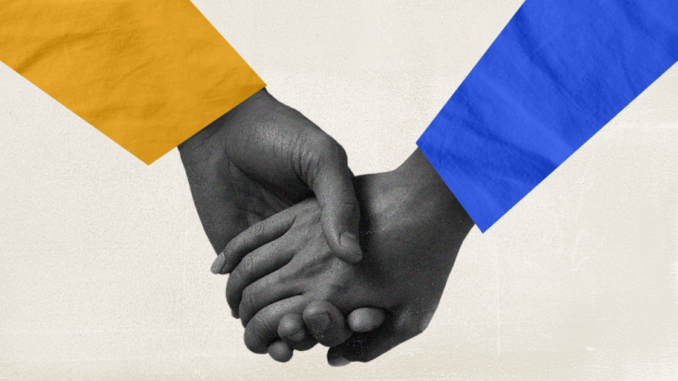
I love holding my friend’s hands, I really do! Handholding brings me closer to the people around me, emotionally when I’m standing next to them and physically when we want to stay close during a busy exit from a concert.
Although I love hand-holding with my friends, I don’t feel comfortable seeing young students being hand-held through their formative years. I’m not talking about our four-year-olds holding their parents’ hands, or grown-ups giving youngsters tablets and electronics to subdue their misbehavior.
Younger generations are being held into adulthood alongside Artificial Intelligence (AI) and coddling parents who are doing more harm than good.
Whether as a future educator or simply a bystander in society, seeing the next generations not get the full experience of going through the motions of life is frustrating, especially knowing that growing up with guidance rather than navigating life blindly made me a stronger adult in the long run.
Help is always a great thing for anyone to have. However, when that “help” is someone doing the work for you, then you’re not being helped, you’re being put at a disadvantage.
Many parents do not allow their children to critically engage with difficult topics and take the time to learn about those topics, even when they have a hard time understanding. This concept, also known as productive struggle, is a dying form of critical thinking outside of the classroom.
Parents aren’t supporting their students in productive struggle, which prevents them from making mistakes. What ends up happening is that students will copy the behavior that their role models have set for them, not feeling comfortable making mistakes because they have never had the space to safely make those errors.
But this handholding is just one side of the coin. There is a thin line between being overly helpful and over-bearingly controlling.
Any parent wants their child to feel safe and sound in their care; it’s only natural that restrictions will be placed on a child to protect them, both in person and online. In a digital age, parents are hyper-aware of the dangers the internet can pose to their children. Therefore, some parents will take on an overbearing nature for their children in an attempt to fully protect them.
This overbearing nature has been shown to hinder kids’ development and prevent a successful transition into adulthood, causing more anxiety for new adults and making more room for mistakes, a topic I previously reported on for The Vanguard.
Both of these forms of handholding are dangerous and painful for growing people. Everyone needs help, but no one is helpless, needing guidance at every step. Let your child figure out which shape goes in what hole, and let the people you care for understand it’s safe to make these mistakes.
This handholding is not only due to parents or guardians, but also from the corporations that see children and minors as their new clientele.
With AI transforming itself from making blurry photos to now being used in various educational platforms, the controversial technology has made its way into the palms of our young students.
With the rise of Artificial Intelligence and the digitization of information, students have easy access to the entire world’s information at their fingertips.
Students have been found to use AI websites like ChatGPT to solve schoolwork at a faster pace. However, consistent use of AI decreases students’ comprehension and critical thinking skills, and for young learners who are building these foundational skills, the use of AI can detrimentally affect their fragile literacy skillset.
As someone who has worked in and studied education for the past three years, teaching and studying students from preschoolers to seventh graders, I have seen how students are easily drawn to the peace of mind AI provides. Pre-schoolers are watching AI short-video content designed around nonsense jokes, otherwise known as “brainrot” content,, and middle schoolers are using ChatGPT to do their homework assignments.
These children are becoming accustomed to the safety net AI is giving them. Fueling the beast that is ChatGPT and continuing to be one of the largest populations using AI, and giving investors more reasons to keep pouring money into AI.
With students taking the easy route with their work and parents being either too strict or too loose, all of this raises a serious question: How can we fix this issue and give our young students back their individual sense of strength?
It takes a village to raise one child, and it’s gonna take communities to change the damage that’s been done. We, as a collective, need to understand where our students’ strengths and weaknesses lie and help them both at school and at home. Making spaces where our students know it’s safe to make mistakes and to embrace their own productive struggles is key to helping them experience their own minds.
The question of how to teach the next generation is as old as time, but if anything is certain, it’s that this is not something we can fix in one layer or in one day.
To all students of all ages: never be afraid to make mistakes and let yourself just relax and enjoy the process of learning. Nobody’s perfect, you just have to work it.