
By: Serena Edwards
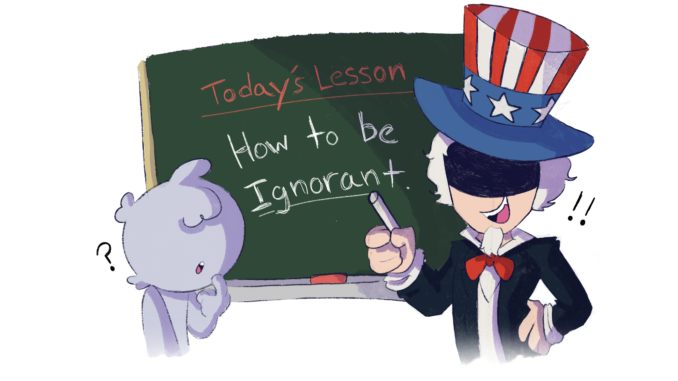
Have you ever watched the show “Are You Smarter Than A Fifth Grader”, where adults test their intelligence against children they feel are inferior in certain topics? Throughout the world, different education systems and media outlets ultimately shape people’s knowledge. Throughout the developmental stages, Americans have been taught to think that ignorance is bliss. The United States (U.S.) has fueled ignorance through its abuse of censorship within the media and the education system.
To build a level of ignorance, you have to start from the beginning, which, in the case of many Americans, school is the beginning of life.
The way the U.S. education system regulates what is taught shapes the knowledge people gain when entering the real world.
The first notable change in the education system was when the U.S. introduced the Common Core State Standards, which was created to ensure high quality consistency in education.
“The Common Core State Standards arose from a simple idea: that creating one set of challenging academic expectations for all students would improve achievement and college readiness,” according to Education Week.
Though Common Core was expected to be viewed positively, the curriculum taught was lackluster and whitewashed. Thinking about what students from 2000 to 2010 have been taught in grade school, Black history was taught through the lens of trauma and rarely mentioned any Black icons past three notable figures: Martin Luther King, Rosa Parks, and Malcolm X, without diving into the complexities of Black history. But the erasure spreads across the diaspora with many students being taught to look at Christopher Columbus as a savior and unifier; however, when diving into the true history, we are hit with the gruesome reality.
Spending years being taught a “beat around the bush” curriculum trains Americans for blindness to truth and shapes a negative perception of other cultures and perspectives.
Intelligence took a major toll during COVID-19, dealing with trauma and having to adapt to virtual learning was a deficit to many students, causing an increase in lack of essential knowledge in the core subjects: math, English, social studies, and science.
Isolation affected basic social skills since after-school programs were being defunded due to economic struggles. The lack of third spaces fueled an isolated mindset. Due to limited exposure to other cultures, we are conditioned to think that only one can exist.
After the pandemic, ignorance took another level: the education scores were dropping, and screen time was rising. The transition for Americans was harder with a lack of educational interactions.
The result of the decline in scores was the implementation of “No Child Left Behind,” (NCLB). Although the initiative meant well in helping educate the new generation, NCLB left educators overwhelmed and stressed with reaching the standards set for them. In the same way, schools gave participation trophies to promote “inclusivity”, NCLB prevents students from encountering challenges.
“NCLB held schools accountable for how kids learn and achieve. It did this through annual testing, reporting, improvement targets, and penalties for schools,” according to Understood.
This portrayed students as test scores instead of humans. This became even more prominent after COVID, when the curriculum provided a range of literacy and prevented students from stepping outside of their comfort zones. A perfect example of this is reading levels. As you progress as a student, your reading level advances as well, usually based on a letter in the alphabet. When a plethora of reading choices is provided, overwhelming emotions arise, leading the student to choose comfort over challenge.
In states like Texas and Florida, book bans within schools have been on the rise, causing a generational drift from the books we know as classics.
“Bans were found in 23 states and 87 public school districts, with Florida and Texas leading in the number of bans,” according to PEN America.
Within republican majority states, citizens are unenlightened about the knowledge of our country and international issues, making them a huge target for manipulation. Take President Trump’s supporters, Make America Great Again (MAGA) supporters, who have been noted to be severely undereducated in the basic practices of knowledge politics.
“At the individual level of analysis, conservatism scores correlate negatively with SAT, Vocabulary, and Analogy test scores. At the national level of analysis, conservatism scores correlate negatively,” according to ScienceDirect.
We used to have an abundance of educational shows that would compensate for the information the school didn’t teach, but over time, the shows faded, and ignorance became prominent.
But the educational system only takes on the developmental years of our lives. For those choosing to pursue higher education, the media we consume influences what we believe and how we function. There have always been rules and regulations within the media; however, policing and censorship took a new level within the Trump administration. For example, major news channels are funded by advertisers, which then curate what can and cannot be published or broadcast.
Channels like PBS and NPR that provided free broadcasting have been defunded by the Trump administration.
“When Congress decided this summer to eliminate $1.1 billion allocated to public broadcasting, it left some 330 PBS and 246 NPR stations, each with unique issues related to their communities and history, to figure out what that means,” according to PBS. This limited the amount of accessible resources to Americans.
The lack of knowledge within America has become apparent in recent foreign political conflicts. With the narrative of foreign countries being poor, uneducated, and more, we are conditioned to think that America is the greatest. Being willfully ignorant comes at a cost; being the biggest target.
“Feigning ignorance is a manipulation tactic that can be used to avoid accountability, confuse the other party, or gain the upper hand in a negotiation. By acting uninformed or confused, a person can deflect criticism, evade responsibilities, or manipulate others into revealing more information than they intended,” states Bryant and O’Connor Law Firm.
In the current political climate, we must pay attention and take the initiative to stay informed and on top of the information around us. Whether that’s reading a print newspaper, watching a documentary, or visiting a museum, we must take action for our students, past and present, to remain educated.