
By: Ameena Khan
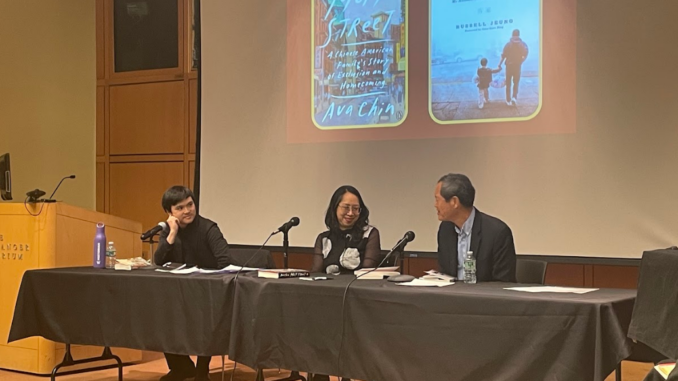
On Wednesday, March 18, in the Woody Tanger Auditorium, Professor and Robert L. Hess Scholar-in-Residence, Russell M. Jeung, held the second day of the lecture series with guest speaker and author Ava Chin and Assistant Professor Alvin Khiêm Bùi moderating the discussion.
Both speakers discussed similar themes of self-identity and discovery among the diaspora, highlighting the importance of family and ancestor history preservation among generations, and “comparing East Coast to West Coast Chinese American experiences,” according to the Brooklyn College website.
“A biography tells the story of a life, while a memoir often tells the story of a particular career, events, or time,” said Bùi when introducing the panel, asking the speakers as to why they chose to label their books as “memoirs” instead of autobiographies.
Both speakers discussed their choice of labeling to emphasize the highlighted experiences of tracing back their ancestors’ history and personal connection to community and identity.
Ava Chin is a 5th-generation Chinese American New Yorker, journalist, Professor of Creative Nonfiction and Journalism at the City University of New York (CUNY), and award-winning author of “Mott Street: A Chinese American Family’s Story of Exclusion and Homecoming”.
The book addressed her childhood in Queens, raised by a single mother, and how being reunited with her father made her realize that generations of her maternal and paternal ancestors had resided in the same apartment complex in New York City’s (NYC) Chinatown on Mott Street.
“So many generations of my family have lived in this building, great grandparents, grandparents, and their siblings, parents, uncles, aunts, cousins, and now me. Each wing of the family can trace its lineage back to an ancestor born and raised in the same fertile river delta, an ocean and continent away,” Chin cited from her memoir.
Chin further discusses her attempts to uncover her family’s history, as well as her relationship to them, questioning why so much of it was hidden, discussing her own feelings of exclusion, unanswered questions when interviewing family members, the impact of the Chinese Exclusion Act fabricating identities, and the erased history of her ancestors’ contribution to America, such as the nation’s first transcontinental railroad.
“ It is a general rule of thumb amongst researchers and historians alike that it is a written record, that is the gold standard,” said Chin.
“But when you’re Chinese in America, with roots that stretch back to the exclusion era, it is the historical record that stretches that is a fabulous fabrication, and the oral stories passed down from generation to generation, like rare evolving heirlooms, that ultimately holds the keys to the truth.”
The Hess Scholar, Russell M. Jeung, a professor of Asian American Studies at San Francisco State University and co-Founder of Stop Asian American and Pacific Islander Hate (Stop AAPI Hate), discussed similar ideas in his own memoir, “At Home in Exile: Finding Jesus Among My Ancestors and Refugee Neighbors”. The book explored his own experience of uncovering family history origins and his own sense of identity and belonging, along with his Chinese-Hakka roots. Jeung compares his journey of finding identity with Disney feature films, beginning to recognize his own Chinese roots.
“There are 47 million other Chinese in the diaspora. That’s not special Disney material at all. Luckily, I knew that in my blood, I’m Hakka, a distinct linguistic group in China,” Jeung shared from his memoir.
“So, when I had a free afternoon while probably in Hong Kong, I went in search of my written Chin Wan district. There, I hope to find clues about my Hakka heritage. Perhaps they could have cool styles of art for music. Maybe I could find records on my ancestors and trace my lineage back for centuries. I long for a metaphorical home, where I could hang my hat, or maybe better yet, in Disney fashion, I could be a descendant of a Hakka king crawling. So I took the subway to this museum for Hakka in Hong Kong.”
Jeung describes his early efforts to retrace his steps and uncover his family’s unique origins, his excitement at uncovering clues and establishing identity, and the moments of disappointment when his expectations weren’t met, leaving him even more uncertain about his identity.
“I expected to enter more interesting exhibits in the other spaces, and the inner rooms were quite barren, too. The living room had a wooden bench and a small shrine, but no specific lattice work, no exquisite pottery, not even decorative flooring. I became increasingly dismayed as the bedrooms in the closet containing typical Hakka clothing further revealed the simplicity of my people.”
When asked about future projects, Chin discusses her current project of a “follow-up book to Mott Street,” focusing on the 1965 Immigration Act and ideas of a potential Mott Street television show project.
Jeung is currently working on publishing a book about “countering Anti-Immigration rhetoric and narrative,” in the rise of anti-immigration sentiment and deportation threats, focusing on the gifts and values of the diverse immigrant community he grew up in.
“I’ll just say for young people,” Chin concludes the panel. “It’s really important if you’re interested in these stories to start now. So, just start asking questions of family members, and because if you don’t do it, then there will come a day where you’re not able to do it.”