
By: Emily Nixon
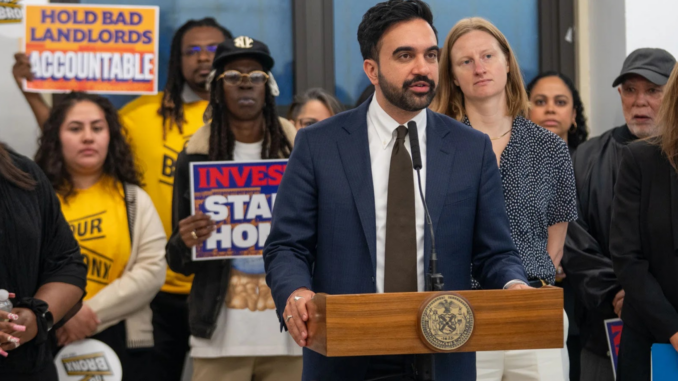
On May 6, New York City (NYC) Mayor Zohran Mamdani, in conjunction with the Department of Housing Preservation and Development (HPD), announced that two Bronx Landlords now owe NYC $31 million in housing regulation penalties, a new record for HPD.
“For years, tenants at Robert Fulton Terrace and Fordham Towers have been forced to live with vermin infestations, chronic elevator outages, and a lack of heat and hot water – while their landlords met their suffering with silence. Today, that neglect is finally met with consequences,” said Mayor Mamdani in a statement. “This administration secured the largest penalty in HPD’s history because no landlord is above the law.”
In addition to the $31 million penalty, NYC froze $900,000 from the owners, Karan Singh and Rajmattie Persaud, according to a press conference held by multiple housing officials, featuring Mayor Mamdani. Singh and Persaud will be required to appoint a “Chief Restructuring Officer” (CRO) who will use the $900,000 to ensure “critical repairs” are made to the “nearly 500 units” within the two buildings.
Mamdani and HPD aim to provide a long-term solution to the potentially dislocated tenants, according to their press release.
“The Mamdani administration is also calling on the Federal National Mortgage Association, Fannie Mae, which has initiated foreclosure proceedings on the buildings, to work with HPD and tenants to identify a preservation buyer who will serve as a responsible, long-term steward of these homes,” stated the press release.
Singh, ranked 22nd, made it onto the 2026 worst landlords list, which is compiled by the number of properties and open complaints against the landlord by the NYC Office of the Public Advocate.
If left unpaid, the $31 million penalty will convert into a lien on the properties, forcing future owners to deal with NYC, according to The Gothamist.
A lien is a “legal claim placed on a property by a creditor to secure repayment of a debt [… that] gives the lender or creditor the right to take action against the property if the debt isn’t paid,” according to Academy Bank.
During the press conference, a tenant of the building asked the panel if any of the money confiscated in penalties would go to compensating the tenants.
HPD Commissioner Dina Levy responded that with the CRO appointment, frozen funds, and the penalties, tenants should see the condition of their buildings start to improve immediately.
“Right now, we’re thinking about emergency repairs, which the tenants have been waiting for. The $900,000 will be part of that. We’ve also been already in direct communication with Fannie Mae […] So, I would expect the building to start seeing that immediately,” said Commissioner Levy. “We’ve been very clear that we are going to be working with [Fannie Mae] to identify a responsible owner for the first time in a very long time for these buildings and one that can work very collaboratively with the tenants and with HPD.”
This is not the first time change has been promised to tenants in the Robert Fulton Terrace and Fordham Towers.
“The story, as the mayor said, is personal to me because I was a tenant organizer in these buildings nearly 20 years ago when real estate speculators first took them out of the Mitchell-Lama program,” recounted Commissioner Levy. “Since that time, nearly 500 families have seen their homes flip from one bad actor to another, landing with the current owners, as the mayor said, Singh and Persaud, who, in addition to racking up 1,600 code violations, have also been featured on the city’s Worst Landlord [Watchlist] year after year.”
This case marks a new stepping stone on the path to a safer housing system through changing the status quo between the landlords and the mayoral office, according to Public Advocate Jumaane Williams.
“I’ve always said that until [unsafe and unchecked conditions are] no longer the cost of doing business, until people are losing their buildings [and] until bad landlords, worse and worse, are spending time in the jail system, this is not going to change,” said Williams. “With an administration committed to housing justice, tenant support, and using all of the tools available to deliver, I’m invigorated by the change that we can create.”
The path to this future has already begun unfolding, according to Williams.
“I have now seen this [change] starting to happen. There are landlords who have spent some time behind bars. There are people who are losing their buildings, and we are finally seeing it no longer being the cost of business,” said Williams. “So, I’m thankful to be in a time and space where tenants’ voices are finally being heard and addressed.”