
By: Margot Dragos
Presented by Brooklyn College (BC), The Ethyle R. Wolfe Institute, and The Robert L. Hess Memorial Fund, “The Pursuit of Success: A Philosophical Examination of Happiness, Well-Being, and Meaning in Life” was held on March 24. Celebrating the release of Professor Christine Vitrano’s new book, this event was the second in a series of events hosted by the Wolfe Institute celebrating the publications of Humanities and Social Sciences (HSS) professors.
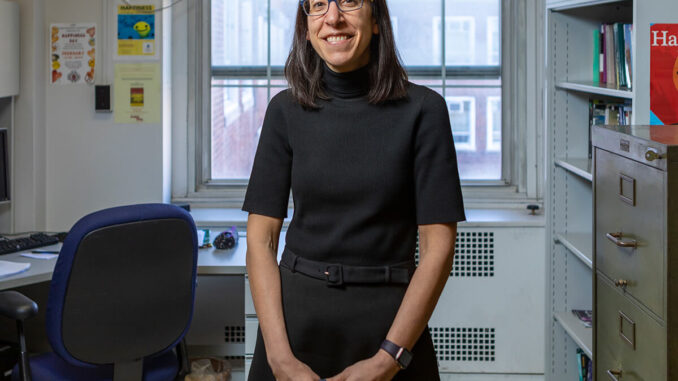
Professor Vitrano is a professor and chair of the Department of Philosophy at BC. This is the third book she has published, and it examines what it means to live a successful life.
Attendees filled Room 411 in the BC library for a talk from Professor Vitrano about her research.
“[I’m] really hoping to pick Professor Vitrano’s brain about what she thinks success looks like, especially in the academic setting,” said Carmine Tepedino, a junior majoring in philosophy.
At the event, Vitrano discussed her thought process behind the book. She said she began with a simple question: How can we live successful lives?
“I think success is actually an ideal we’re all chasing, even if we haven’t thought about it,” Vitrano told attendees. “And if you think about it for a minute, the desire for success is always present. Whether in our careers, or our personal relationships, in our activities, or even our hobbies, nobody wants to fail, and nobody wants to be mediocre.”
Vitrano’s book argues that in order to live a successful life, you must also be living a happy one.
“I think we overlook the possibility that a person can be dissatisfied with even the most impressive careers, even the most impressive accomplishments,” said Vitrano. “They have all of the external wonders we typically associate with success, but I argue in the book that happiness is a matter of being satisfied with your life.”
She told attendees that she first got the idea for the book during the pandemic. Googling how to make sourdough starter led her down a rabbit hole and gave her an algorithm filled with videos detailing how to achieve success. Through this, she discovered her view on success differs from social media.
“It occurred to me that, you know, there’s all of this advice out there about every aspect of our lives, our relationships, our careers,” said Vitrano at the event.
“But I also noticed what was missing from this discussion, and that was a sort of discussion about the bigger picture question of how to achieve success in your life overall. Surely, I thought, if achieving success in all these little areas is so important to us, isn’t it also important that we live successful lives?”
She gave examples of different life scenarios throughout the talk, such as Harvard graduates who are successful in their careers but unhappy in their personal lives.
“If having all these external markers of success doesn’t actually make you happy, is your life really a success? My view is that it’s not,” said Vitrano. “Because if your life really were successful, you wouldn’t have such a strong desire to change it.”
“So one of the aims of this book is to expose the flaws in many of our beliefs about success, which largely overlook what happens internally in favor of what happens externally.”
Professor Vitrano also describes how parents may project traditional ideals of success onto their children. As a parent herself, she has seen many other parents feel pressure to place their children into activities that will set them up for a successful future.
“Our children’s success in life will depend on their ability to discover what will bring them satisfaction. But this may not fit the mold that we as parents have for them,” Vitrano told attendees. “And rather than forcing them along the path that we think will lead them to success, I think that we should give them the freedom to figure out what it is that will actually make them satisfied.”
There is one caveat to Vitrano’s philosophy that she describes. She says that some people may achieve satisfaction by doing immoral things, but this isn’t necessarily a successful life.
“My feeling is that when we describe a life as successful, we are describing it as a good life to live. We’re commending it, we’re praising it,” said Vitrano. “And I don’t think that you can praise an indecent life. So I think you have to be at least minimally decent in order to be able to say that your life is successful.”
A yellow brick road appears on the cover of the book. This came from a comment by Vitrano’s father, who said he associated the pursuit of success with that image.
“You’re trying to find your way, and there’s a lot of misdirection,” Vitrano told The Vanguard. “But hopefully, you stay on the yellow brick road, and you find your way.”
Vitrano hopes BC students use her book to learn to reflect on their values and how they can bring themselves happiness.
“I hope they realize that prioritizing your own happiness is important, but thinking about your own happiness is important, too,” said Vitrano. “In my view, happiness is a matter of being satisfied, but your satisfaction is a reflection of your values.”
“I think the key to being successful is actually really simple: Find something you love, something you’re passionate about, something that you can devote your life to, and do it. What you do…it doesn’t matter, right? What matters is that whatever you do contributes to your own satisfaction with your life.”
“The Pursuit of Success” can be purchased through Bloomsbury Publishing. Students interested in the Philosophy department can visit the department’s office in 3308 Boylan Hall.