
By: Ameena Khan
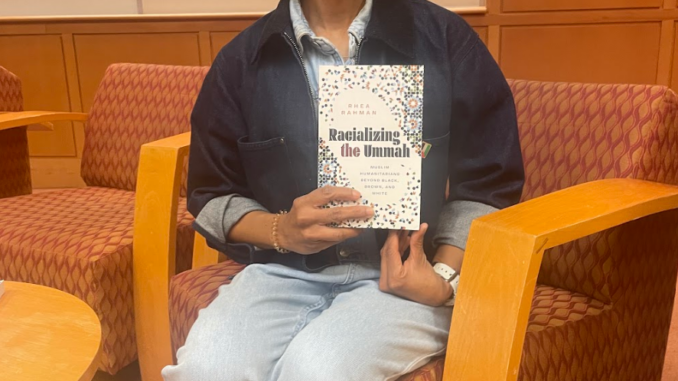
On Thursday, April 23, in the Woody Tanger Auditorium, Rhea Rahman, an Assistant Professor of Anthropology at Brooklyn College (BC) hosted a panel discussion for the launch of her new book, “Racializing the Ummah.” The discussion was moderated by Jeanne Theoharis, Professor of Political Science at BC and featured the following panelists: Corinna Mullin, an Adjunct Professor of Political Science at BC and John Jay School of Criminal Justice, Saadia Toor, Associate Professor of Sociology at the College of Staten Island (CSI), and Christina John, staff attorney on the Legal Team at the Council on American-Islamic Relations (CAIR-NY).
Racializing refers to the act of imposing social, political, and cultural categorization onto groups of people that did not previously identify as such. Throughout the panel, the discussion centered on the anthropological lens regarding how the term “Muslim” is utilized as a perceived racial category in today’s society.
Rahman highlights in her book how not only are Muslims racialized under Western imperialism and white supremacy, but also how those racial hierarchies persist within the “ummah”, or Muslim community, as well as the City University of New York’s (CUNY) failure to protect their Muslim students and staff.
“Racializing the Ummah” serves as an ethnography–a qualitative, in-depth study of human cultures and societies from long-term immersive observation and participation– of Rahman’s experience in charitable work. This work can be seen in her contributions to the Muslim humanitarian organization, Islamic Relief, and its limitations regarding a critical empirical question of “What does it mean to do good?”
“There are these universal values of preserving human life, and how universal they are, yet never post-colonial critique about the hegemony of Western ideas,” Rahman elaborates. “I was curious if an Islamic organization was different, and it ended up with racializing the ummah as broadly thinking about how our Muslims, as a group, racialized, both in the U.S., but also transnationally and globally.”
Rahman considers both her experiences as a non-Black person of color working in Africa with “Islamic Relief” and her personal experience growing up in a racially segregated Muslim community, causing her ideas of race to clash frequently. “[…] and so thinking of how Muslims as a group are racialized, asking this question of what it means to do good forces me to confront both how Muslims are a group of people, racialized, but then also, how does racialization happen within Muslims?”
Rahman challenges the Western depiction of the “good, moderate Muslim” that is “depoliticized” in the Western world and made to resist or question imperialism.
“As soon as Muslims make political claims of ‘What kind of world am I seeing?’ Or what it means to be free, what is liberation, or what is justice. As soon as those ideas of, as those ethics kind of come into conflict with Western imperialism, hegemonic ideas, racial capitalism, that is then when the Muslim becomes a problem.”
Rahman stresses how the racialization of Muslims did not begin on 9/11, but rather was amplified after the attacks by increasing the pressure on Muslims in the West to present themselves as “the good Muslim.”
This can be seen as Muslims working with “Islamic Relief” to pose as “non-threatening” in a world where Muslim becomes synonymous with “problematic” under a Western organization. This establishes a more “palpable” Islam that does not question Western imperialism and its role in destabilizing the same nations it provides aid for, emphasizing the racial hierarchies that are further normalized by Muslim aid workers in Islamic humanitarian organizations.
“‘Islamic Relief’ is a [United Kingdom] (UK)-based Islamic organization. So I was interested to study them because it forces a confrontation with the idea that Islam is completely antithetical to the West,” according to Rahman. “They’re both a Western organization, and they’re working in the UK with kind of Western partners, and they’re Muslim. And so they have to be ‘the good Muslim.’”
Rahman then emphasizes the terms “islamophobia” and “anti-Muslim racism” in her ethnographic work to define what discrimination against Muslims has been labeled as throughout history.
“I mentioned in the book, people who started using anti-Muslim racism were foregrounding white supremacy in their analysis. And more often, capitalism, as opposed to Islamophobia, was coming from another kind of disciplinary lineage that was more post-colonial, de-colonial, and was naming the West and modernity, which is also really important because of the important kind of line of thinking and scholarship.”
Rahman contrasts islamophobia with anti-Muslim racism, which targets racial dynamics, racial capitalism, and surveillance. However, Rahman additionally highlighted the historic importance of the use of the term “islamophobia” used by UK Muslims to emphasize epistemic violence and the politicization of Muslims by the state.
“[Islamophobia] comes from the Muslim community in the UK. To me, because there have been ways of recognizing, I think there’s parallels with the origin of using Islamophobia to antisemitism; a name for racial targeting of a religious community and identity. Muslims in the UK trace it particularly after what’s called, like, the rushing affair and the targeting, the protest […] and the ways the state responds to Muslims. It’s traced as a moment of kind of politicization of the Muslim community in the UK. And given the targeting from the state, people start using this term.”
Rahman and other panelists discussed the surveillance of Muslims and erasure of Islamophobia being addressed on campus and concluded by raising the question: “Is it the job of the institution to protect its students?”
“Columbia University and the City University of New York were rated the most ‘Hostile Campuses,’ each with an extremely low percentage score of just 2%,” according to CAIR’s 2025 Hostile Campus Ratings Report, research contributed by Christiana John, an attorney who has assisted Muslim students affected by CUNY policy. “‘A Hostile Campus’ is one where institutional actions or campus climate make students feel unsafe, targeted, or discriminated against.”
One student in the audience agreed with John, emphasizing that the Muslim Student Association has historically been singled out, provided small spaces to gather, and faced difficulties with arranging rooms for Muslim students to pray.
John critiqued the lack of policies protecting Muslim students at CUNY.
“You’re just not even acknowledging that Muslim students, who, by the way, are not a monolith. Muslim students have a very different experience. Our students who are perceived as Muslim also have a very different experience at CUNY and can experience a very specific kind of discrimination at CUNY.”
To purchase Rhea Rahman’s book, you can visit the University of Minnesota Press’ website.