
By: Samuel Mortel
The use of Artificial Intelligence (AI) to spread political misinformation has been a concern for a long time. Famously, in 2018, Director Jordan Peele sounded the alarm concerning deepfakes in a PSA where he impersonated former president Barack Obama. Since then, this technology has only become more advanced and accessible. In less than a decade, our speculation of a potential future has become our current reality, and generative AI’s improvement has perfectly coincided with an incredibly consequential midterm election. With so much on the line, political campaigns throughout the country have been utilizing AI in their ads, blurring the truth.
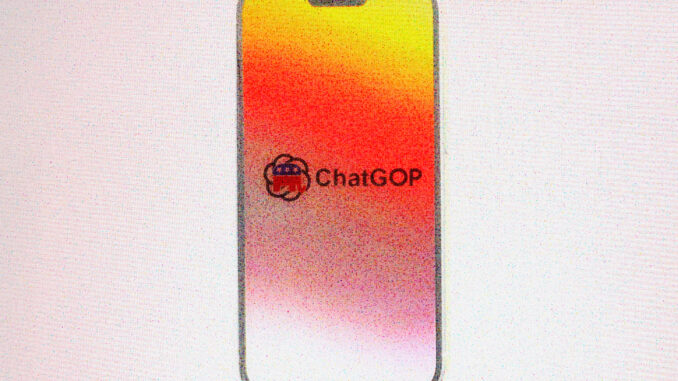
However, it’s clear this tactic is more popular on one side of the spectrum than the other; conservatives love AI. It’s rare to see a technology like this transform into such an ideological weapon, but it seems that AI has somewhat become tied to the conservative agenda, and when you think about it, it’s not hard to see why.
Solid evidence shows that AI is becoming an increasingly ideological issue. In a Pew Research Center poll, the percentage of liberal Democrats who say they’re concerned about AI has risen from 45% in 2023 to 63% today. On the opposite side of the political spectrum, Conservative Republicans have grown more positive, with their concern dropping 14 points in the same time span.
The Republican Party’s foundational use of AI was established by the party’s leaders. The most powerful conservative in the world, President Donald Trump, has had numerous headline-worthy uses of AI in the past year or so. Some of the most notable examples include: himself as the pope and Jesus Christ, videos of Former U.S. President Barack Obama and Former First Lady Michelle Obama as apes, a video of himself in a fighter jet defecating on liberal American civilians, and a video of “Trump Gaza,” a gaudy, gold-plated vacation destination being built on the demolished city of Gaza in Palestine.
Since Trump took the reins as the leader of the Republican Party 10 years ago, the movement’s leaders have learned to reflexively follow his lead. Thus, tightly contested Senate races in Texas and Michigan have become a hotbed for AI in politics.
In Texas, Republican Ken Paxton is facing off against progressive Democrat James Talarico. Talarico has been seen as a real threat to flip a seat some thought might be a foregone conclusion. Because of this, he’s been the target of numerous absurd deepfake ads, including a recent one featuring him wearing a dress. In an equally heated Michigan Senate race, progressive Democrat Abdul El-Sayed has been targeted by AI ads from conservative Trump-ally Mike Rogers. The AI-generated video depicts him as an Odysseus-type figure bringing a Trojan horse of radical policies into Michigan. Overall, a recent CNN article found “about 96% of the spending on ads that disclosed AI use came from GOP campaigns or groups.”
However, this correlation between AI and conservatism isn’t just confined to Trump and his sycophants in the American Republican Party. Even before our newly re-elected president posted videos of him overseeing the arrest of Obama, or Ken Paxton’s campaign posted a video of James Talarico in a dress, the German far-right political party Alternative für Deutschland (AFD) were innovators in using AI to make bigoted propaganda. Back in 2024, the party was appealing to voters with ads featuring AI-generated imagery of a nostalgic, beautiful past and a modern-day Germany overrun with scary foreigners—familiar narratives used to build fascist movements since the birth of fascism as a concept.
As we speak, Brazil is in a grueling presidential election shaped by AI. The race between leftist incumbent Lula da Silva and right-wing candidate Flávio Bolsonaro has been flooded with AI-generated memes, plain misinformation, and just bizarre phenomena. If Bolsonaro’s name sounds familiar, he’s the son of former right-wing president Jair Bolsonaro. The elder Bolsonaro is currently serving a lengthy prison sentence as a result of a Jan. 6-style attempted coup, but his presence is still apparent in the election through AI videos.
Da Silva’s campaign has even gone so far as to allege that this disparity is part of a deliberate bias held by Meta.
“Mr. Lula’s campaign also pointed to a recent report by a global independent watchdog group, Ekō, which said Meta allowed shadow accounts, some run from outside Brazil, to buy political ads that pushed disinformation and deepfakes generated by artificial intelligence to Brazilian voters.”
It begs the question: why is there such a strong, demonstrable connection between conservative
politicians and AI?
Throughout both of Trump’s presidential terms, he’s been known as a prolific liar. It’s gotten to the point that holding him accountable and fact-checking him has become a Sisyphian task or, to use another Greek analogy, like battling a hydra; for every lie you debunk, two more pop up in their place.
Trump’s success has always been based on the idea that people will believe him at face value, whether it be him pitching himself as the “peace president” and then starting a new war with Iran a year into his second term, promising a border wall that Mexico will pay for, which he failed to accomplish, or portraying himself as some genius businessman even though he’s had countless fraught business endeavors and was often in several million dollars of personal debt.
Trump, and the GOP overall, thrive in a world where the truth can be obfuscated. It’s no coincidence that you’re more likely to be left-leaning if you have a college education (though conservatives will often attribute that to some sort of institutional indoctrination). Conservatism is a small-minded worldview that subsists on either misinformation, plain ignorance, or a combination of the two.
It’s no surprise, then, that conservative leaders all over the world are more than happy to embrace a technology that can be used to distort the truth and use the most visceral, provocative imagery to excite their base. You don’t need to provide an actual argument for why you’re better than the other side, just generate a picture of yourself as Jesus and a video of your Black opponent as a monkey. You don’t need to pick apart your opponent’s arguments, just generate a video of them averring something they didn’t actually say.
To be frank, this technology is perfect for taking advantage of people who are easily duped or at least easily swayed. Conservatives across the world have realized this and have fully adopted it as a tool to gain support.