
By: Renae Visico
Indigenous music and the smell of fresh Filipino barbecue reigned the halls of the Leonard and Claire Tow Theater, filled with the cheerful sounds of BC students. On Oct. 16, the Brooklyn College Asian American & Native American Pacific Islander-Serving Institution (AANAPISI) Project (BCAP), Student Activities & Involvement Life (S.A.I.L.), and the Wolfe Institute collaborated to hold the second annual Pasifika Fest, gathering students from various cultural backgrounds to celebrate Filipino and Indigenous culture.
The BCAP staff members chose to host the Pasifika Fest in the month of October to honor Filipino-American Heritage Month and in anticipation of Native American Heritage Month in November.
The Pasifika Event was organized to bring awareness to Filipino and Indigenous experiences that are often overlooked in American history and culture. The word “Pasifika” originated from native Polynesians and is used as an umbrella term to refer to Pacific Islanders.
“When you think about Asian-Americans, usually people think East Asian,” BCAP director Megan Go told the BC Vanguard. “That’s why we wanted to highlight that Pacific Islanders are still a part of that community as Asian Pacific Islanders.”
Students were drawn to attend for various reasons, but most came intending to learn more about cultures different from their own.
“I heard about the Pasifika Event, and I’ve been trying to go to more events around campus, and especially cultural ones, to appreciate different cultures around the world,” said BC junior Aaron Jean Francois.
Others, such as first-year liberal arts graduate student Isabel Clarkin, came to witness and celebrate the diversity of Brooklyn College’s student body.
“I wanted to learn more about historical contexts, especially having such a diverse group of students. It feels better to learn more about different cultures,” said Clarkin.
The event began with opening remarks and a land acknowledgement from Go, honoring the Indigenous culture that the Pasifika Fest was organized to highlight.
“We begin our proceedings today by acknowledging that we are gathered on Lenapehoking, the ancestral lands of the Lenape peoples,” said Go. “We do this with humility and gratitude, while recognizing the violence of forced relocation and displacement of the Lenape Peoples with whom this department and college are in an ongoing process of learning.”
History professor Alvin Bui Khiem was then brought to the stage to introduce the launch of the Asian American and Diasporic Studies minor. The 15-credit minor consists of one American and one Asian history course that fulfill pathways requirements, as well as three elective courses with options to study Asian-American & Pacific Islander (AAPI) communities, literature, and more.
“Race in the U.S. context has often focused on the ‘black-white binary,’” Professor Bui told the BC Vanguard. “Courses in the minor address Asian Americans’ positionality in relation to both whiteness and blackness through an interdisciplinary understanding of the ‘model minority myth.’”
Interested students can declare this minor as early as the current fall semester or the upcoming spring semester.
The minor’s soft launch was followed by a poetry reading by Filipino poet, I. Buenaventura, otherwise known as Patrick. An activist for LGBTQ+ rights who identifies as transmasculine and nonbinary, Patrick writes poems to document their transition to give support to the trans community and spread awareness of the hardships queer Asians face in America.
Patrick read a series of six poems collectively titled “Real ID,” which was published in Issue 6 of AAPI magazine “slant’d.”
“Real I.D.” described the difficulty and pressure to put their complex intersectionality in a box: “A half century of Queer, Trans, Asian flesh. / Identification like a cudgel.”
“The TSA enforced security of airports and required travelers to present government-issued photo identification for domestic flights,” Patrick explained, the REAL ID Act of 2005, and why they named their poem after it. “And it’s one of the ways that they’re trying to erase trans folks, but to me, I’m telling people that it’s impossible. Because they’ll always be here.”
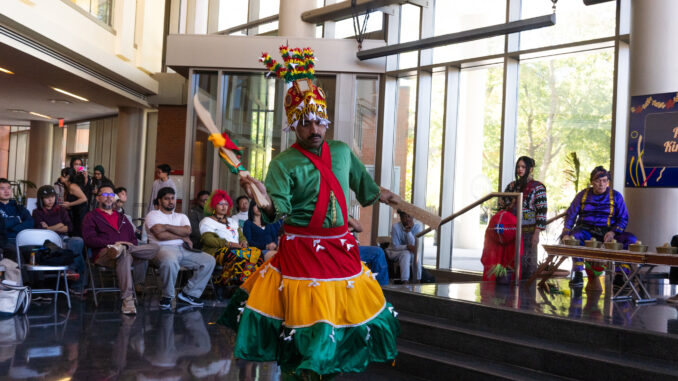
Patrick’s reading was followed by performances by Dancers Unlimited and Kindig Sindaw.
Create, a dancer from Dancers Unlimited, performed a powerful interpretive dance to convey the struggle many immigrants and diasporic peoples face to remember their roots in an environment where they’re often forgotten.
“You hear things in your family, like, ‘we have Jamaican, or you know we have some Native American’, but you don’t have specifics on anything,” Create told the BC Vanguard. “So it’s kind of like, I don’t know if it’s true or not, and then it’s a shame. That’s what I was trying to get people to feel, is there is a struggle. But also feeling the sadness of having to even struggle in the first place.”
Kindig Sindaw, an NYC-based non-profit theater and dance company, gave the audience a Filipino history lesson before giving dance and martial arts performances to tell stories of Indigenous Filipino epics and cultural traditions.
“As Filipinos, we are performing here. Not entertaining,” said Potri Ranka Manis, founder & artistic director of Kindig Sindaw. “We’re performing to remind everyone that we are existing, that there is a living tradition, and everyone has to stand in solidarity.”
Potri was able to help students learn about not only Filipino culture itself, but also how their experiences and history relate to a broader international scale.
“I learned a lot about history in general and how people are connected,” said first-year school psychology graduate student Arlene Mercedes de la Cruz. “I know a lot of Spanish words, and they also connect with Arabic words that connect with the Philippines. So it was nice to see how we’re all connected.”
The students and staff members at BCAP felt an extra weight on their shoulders while organizing the Pasifika Fest, as they had recently received the news that the Trump administration had cut $350 million in federal grants that funded Asian-American and Hispanic-serving institutions, including AANAPISI.
“To further our commitment to ending discrimination in all forms across federally supported programs, the department will no longer award Minority-Serving Institution grants that illegally restrict eligibility to institutions that meet government-mandated racial quotas,” said U.S. Secretary of Education Linda McMahon in a statement from the Department of Education (DOE).
In that same statement, the DOE shared its intent to redirect funding towards programs that “do not include discriminatory racial and ethnic quotas and that advance Administration priorities.”
This announcement came with backlash and frustration from House Representatives and the BC community alike.
“President Trump’s slashing of MSI funding will rob millions of their shot at the American Dream,” said CAPACITY Chair Emerita Rep. Judy Chu. “This will hurt not only students of color, but also every single student at these higher education institutions, since all students are able to benefit from these programs.”
The AANAPISI Project at BC has been granted an extension to run until May 2026 with their remaining funds, but staff members are facing uncertainty for BCAP’s future.
“We were hit with this funding cut, so things were kind of a bit up and down for me. I wasn’t sure how long I was gonna be able to stay,” said BCAP Program Coordinator Jamie Chan. “But we are ready to do this work, you know? There’s a lot of students who are interested and who really take advantage of our space. […] So I feel like it’s just very profound, the amount of meaning BCAP has for students.”
For many Asian students, BCAP is more than just a place to stay in between classes. It’s a safe space for everyone, whether or not they identify as Asian, to come together to foster meaningful friendships and a cultural community.
“It really changed everything for me, cause I met so many new people, so many friends. I feel more social now,” said BCAP Program Assistant Lily Dionisio. “I met so many besties at BCAP. Working here just feels so meaningful.”
“I go there all the time when I’m bored, when I’m needing to study, or when I just want to hang out with my friends,” said senior business student Shuhana Begum. “I feel like BCAP would be my second home.”
The Pasifika Fest exemplified BCAP’s commitment to break the pattern that has silenced underrepresented cultural voices, even in the face of uncertainty and adversity.
“What really separates us from other student clubs and organizations would be the fact that we really do emphasize the cultural heritage,” said Andrew Huynh Vo. “We always try to uplift voices that are being stuck under the rug.”
Students interested in the Brooklyn College AANAPISI Project (BCAP) can visit their Instagram: @bcap.brooklyn or visit Boylan Hall 2153.