
By: Raven Santos
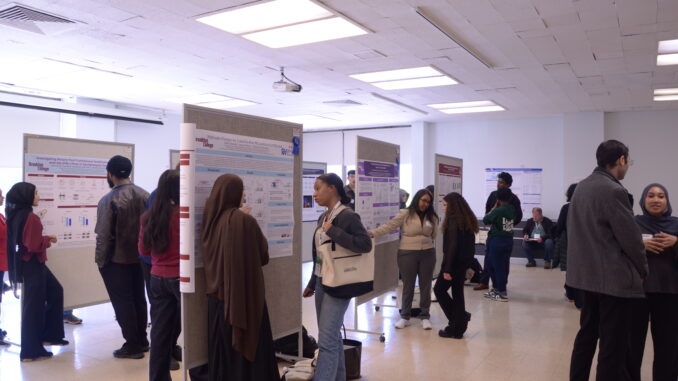
On May 8, the Student Center was filled with posters lining the rooms, and students who exuded creativity and innovation. The students were hosted by the student center at the 35th Annual Professor Louise Hainline Science Day, where undergraduates and graduate students present research projects to a panel of judges.
The topics traversed all avenues of the sciences: biology, chemistry, psychology, ecology, and computer science. While assisted by the college staff, all the presenters were driven by the unrelenting curiosity and drive that each of the students brought to their research.
One of the presenters was Mariam Bekhet, a Health & Nutrition Sciences undergraduate student, who worked with the Brooklyn College Cancer Center to research methods for improving body image and self-esteem among cancer patients and survivors.
Bekhet initially “wanted to focus on breast cancer survivors, but there was not a lot of research that focuses on the survivors, and a lot focused on the patients.” The experience of reviewing all the studies had been new and overwhelming for Bekhet, but after her systematic study, she “was surprised at how many interventions focused on the quality of life for patients and survivors.” Bekhet shared that the research changed her perspective on “that the research was [entirely] focused on treating the actual disease.”
The presentations weren’t limited to undergraduate students, as some presenters were students from Midwood High School, students like Zuvi Quang.
Quang was researching protein interactions relating to the BRCA1 and PALB2 genes that both increase the risk of breast cancer. By creating 3D protein models made from observed DNA sequences, she was able to analyze how these interacted. She says that, in knowing this, she hopes to show that “these interactions between BRCA1 and PALB2 are extremely specific in interactions, and how the mutations could lead to an increased risk in breast cancer”.
She had wanted to conduct this project because the news of one of her favorite actresses, Angelina Jolie, possessed a gene that increased her chances of breast cancer, and this had inspired Zuvi to conduct research with her mentor, Dr. Shaneen Singh. Carrying on after high school, she’d wish to further test the models and hope to see more progress in the field of cancer research.
Another presentation was given by biology senior Jean Marseille, who focused on the ASH1L and SETD2 genes, which, when mutated, are likely causes of Autism Spectrum Disorder (ASD). He was analyzing whether these genes were affecting the cells’ metabolic pathways in the brain, which in turn would likely be a cause of ASD.
This was a massive research project conducted at Brown University with the help of the Leadership Alliance. By creating 2D and 3D models of brains with mutations in the ASH1L and SETD2 genes, Marseille was able to test for specific proteins to assess whether this metabolic pathway was affected. Before stepping into the project, Marseille didn’t have a full understanding on what the autism spectrum disorder was. Upon completion, he has a better scope on the topic and aims to further his research in hopes to “provide a framework [to shows] that the metabolic pathway could be an area to look at within the autism spectrum disorder phenotypic behaviors.”
At the end of the event, all the presenters and judges gather in a lunchroom to present awards. Zuvi Quang had won the award for best presentation in the High School Students Division. Peter Tolias, the Dean of the School of Natural and Behavioral Sciences, said that a continued pursuit of Brooklyn College is to “increase [the school’s] research profile across CUNY and across the country”.
Tolias said that steps have been made to support the students by “getting resources to rebuild the campus […] renovating buildings, replacing all science equipment and research equipment, and bringing in younger new faculty, with innovative new science programs to help the [students] build fruitful careers in the sciences.”