By: Michelle Zhen
When we scroll and especially “doomscroll”—mindlessly consuming social media content that makes us feel worse than when we started—we sacrifice a part of ourselves to become one with the thousands of people who do just that every day. To prevent this, we need to understand the root of the problem to reclaim our identities and do what we really want with the time we have for ourselves.
The trick to reducing screen time is to replace scrolling with a personally fulfilling activity.
The “infinite scroll” is most often attributed to Aza Raskin, who, in an Oppenheimer-esque repentance, co-founded the Center for Humane Technology in 2018.
He has since expressed his regrets, claiming the invention is “one of the first products designed to not simply help a user, but to deliberately keep them online for as long as possible”.
It’s impossible to avoid having a phone. The world won’t compromise for a handful of phone-havers abandoning a part of what may very well be their flesh and blood in 2026. As a major advancement in globalization, the handheld phone connects us to the world just as effectively as it can distance us from it. The same person who solely takes asynchronous classes is just as capable of texting hundreds of people across the globe.
This dependency on cell phones and everything it’s connected to can make it difficult to pinpoint an addiction in the first place. It’s perfectly normal to have a phone, to use it regularly, and to have an active social media account (multiple, at that.) Is it so wrong to breathe air and keep a water bottle at hand?
The phone isn’t the problem; it’s how we use it. Most “doomscrolling” happens during downtime, or whenever we aren’t doing something important, like working or talking with someone. Some scroll even when working or sitting in class simply because they don’t think it’s important enough for their full attention; perhaps their primary activity is just boring. Some take minutes of their 24 hours daily to find the perfect YouTube video to accompany their meals, delaying the very meals they’re there for in the first place. Perhaps that person is you; well, it used to be me, too. However, this is not true relaxation. Humans were never meant to have so much constant stimulation throughout the day; in our roughly six million years walking this earth, the telephone has accompanied us for twenty-five ten-thousandths of a percent of that.
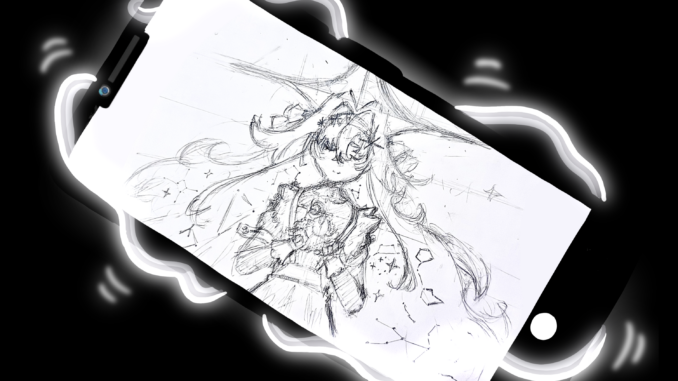
To reclaim your life, you have to know what your life is in the first place. That can be hard, especially as the majority of our readership was raised on cell phones, but there is one route to ourselves paved through artistic pursuits. The rise of journaling trends on TikTok and the revival of analog watches and Polaroids are testaments to a rising desire to reclaim our lives and create. In an age of AI chatbots, journaling can be aesthetically pleasing, but it can also be about lists, doodles, simple reminders, and more. What would you do if you had all of the time in the world? Would you still reach for your phone?
Creating is one such pathway to understanding ourselves. As social media grows disillusioned with itself, with its users opting to trend journaling topics and beautiful art, many people are choosing to forgo mindless consumption for meaningful creation. For example, by writing this very article, I am communicating my solution to this problem I see every day. You can agree, disagree, or perhaps have a secret third opinion, but the most important aspect is simply to think the thought; that way, you will have made something today, something beyond the screen, and I have successfully created something worthy of your time and thoughts.
The original goal of the internet was to connect people reliably and regardless of distance, yet many “digital natives” are lonelier than ever, knowing little beyond the entire world’s knowledge in the palm of their hand. However, the road is a guideline, not a rule; by taking an original path through personal pursuits beyond the screen, perhaps all of us could become more than we even predicted. Maybe that path will look like a paper and a pen, so long as something is written. Perhaps the path to improvement starts with an essay no different from this one.
Yet, no matter what, the outcome is simply up to those who tread that unknown path.