
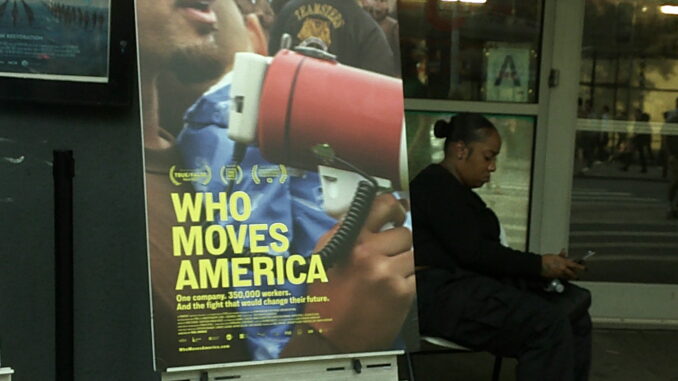
By: Amani Nelson
On Wednesday, Sept. 9, the IFC Center, an art-house movie theater, hosted a film screening for the opening night of “Who Moves America.” Following the screening, a Q&A featured the producers and members of the International Brotherhood of Teamsters, a large-scale labor organization.
The 87-minute documentary follows workers at the largest shipping courier, United Parcel Service (UPS), as they try to unite their nationwide 340,000 co-workers to fight for a better contract, preparing for what would’ve been the biggest strike since 1997.
When journalist Alex Press asked about the intention behind making the film, producer Jeremy Flood said he wanted viewers to be educated.
“We wanted [the film] to be educational […] We wanted people who, even if you have no relation to the labor movement, you can sort of watch this movie and [understand] how the process happens.”
Keeping up with those intentions post-screening, volunteers handed out postcards for audience members to write their goals and union knowledge to share with future audiences at other screenings. Sign-up sheets were also passed around to encourage people to contact their fields’ local union.
A major advocate and contributor, the Emergency Workplace Organizing Committee (EWOC), also appeared, promoting itself as a volunteer grassroots organization that helps workers take back power in the workplace by providing resources such as training and workers’ circles.
With a collective interest in themes of solidarity and labor, producer Yoni Golijov revealed how the idea for the documentary came about.
“[At] the end of 2022 […] I reached out to a friend who works at UPS, and I was like, Hey, I wanna make a film about this. And he was like, well, you know Mars [Verrone]? Because [Verrone] just asked me the same thing. Do you know Jeremy [Flood]? Because [Flood] just asked me the same thing. And so we were like […] let’s all meet.”
Reflecting on the producers’ frequent collaborative efforts, producer Yael Bridge shared her viewpoint on how collaboration molded this film’s outcome.
“Filmmaking is inherently collaborative […] you’re working with a bunch of different people and the way I like to work is in a team. And I guess that is informed by my politics, and that is also something I bring to all of my projects,” said Bridge. “There are four producers, and we all made decisions together.”
Watchers get an insider perspective of what Teamsters had to endure through the lens of shaky wide shots and medium close-ups of drivers loading boxes onto trucks paired with older news clips and interviews shot on older cameras from the original strike in ‘97.
A statement from Teamster member Antoine Andrews later co-signed those claims when responding to a viewer who asked about the influence this film may have had on workers’ conversations beyond their contract. Andrews reflected on working with fellow Teamster Antonio Rosario, fighting for the rights of Amazon workers, and that connection to Teamsters combating UPS’ efforts to undermine their efforts by doing things such as trying to eliminate paid holidays. “We want everyone to recognize that this is a battle for the working class, and this labor movement has to continue,” Andrews said. “So the conversations are real, the conversations are happening.”
The conversations are still happening, since viewers were shocked to learn that by the end of the film, a new contract was agreed upon and a strike never happened because of mixed feelings about the terms of the new contract. Instead of framing it as a negative, the producers presented it as a realistic outcome of collective effort that can still be viewed as a success, even though the intended goal didn’t manifest as expected.
Following the in-theater Q&A, attendees began to disperse into the lounging area. Volunteers at Many Hands Workshop took photos in front of the event banners.
Flood expressed his satisfaction with the project.
“[The] great thing about working on something like this [is that] you can see how ordinary people, when they work together, can take on the most powerful forces in the world,” Flood said.
Following his sentiments, Teamster Andrews placed more emphasis on why a documentary like this is so important.
“This film has definitely impacted my life in a significant way, because it just gave me that extra confidence and encouragement to continue to fight for what’s right, to continue to fight for what I deserve,” Andrews shared. “[The film] definitely encouraged me to encourage those who are coming behind me to fight, because I won’t always be around. So we have to keep that train rolling.”
And so, the posters began to come down, and the crowd began to thin as people made their way out of the closing theater with the story of the UPS Teamsters still fresh in their minds.
To close out the film’s opening night, Golijov expressed the importance of stories like “Who Moves America.”
“The only way we’re going to defend our rights is doing it together, and at the workplace, we have a lot of power.”
IFC Center will be hosting screenings and Q&As with special guests for ‘Who Moves America’ from September 12-14, with regular screenings closing out on September 17.