
By: Ameena Khan
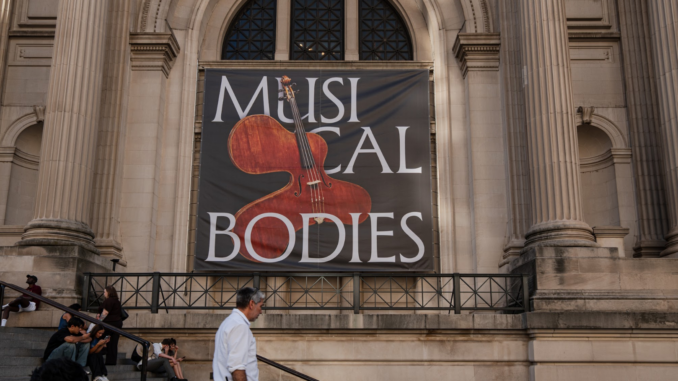
From June 7 through Sept. 27, The Metropolitan Museum of Art (Met) opened a new exhibition, “Musical Bodies.”
The Met brings together the earliest depictions of musical instruments throughout various civilizations to understand the evolution of musical instruments and their relationship with the human body today. The exhibition questions the relationship between musical instruments and the human body, which are interconnected as one.
Funded by Barbara Tober, the Diane W. and James E. Burke Fund, the William Randolph Hearst Foundation, and the Gail and Parker Gilbert Fund, the exhibition was curated by author Bradley Strauchen-Scherer.
“The ‘Musical Bodies’ exhibition is an attempt to get us to think about the role that musical instruments play in our lives as being central to human identity and human activity,” Strauchen-Scherer stated in the Virtual Exhibition Tour.
“This exhibition brings together instruments, artworks, sculpture, and artifacts of pop culture from over 10 curatorial departments at The Metropolitan Museum of Art, and over 30 lenders from the US and abroad, around 130 works of art.”
As visitors enter the gallery, they are welcomed with an immersive experience of various forms of music and art.
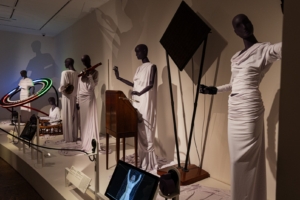
Visual displays of paintings, illustrations, musical dresswear, statues, and personified musical instruments such as “Venus and the Lute Player” (ca.1565-70), “Repatriation of Tipu’s Tiger” (2022), “Woman’s Under-Kimono (Nagajuban) with Piano Keys and Libretti from Two Songbooks” (ca. 1930s), “Six-armed Mahakala” (18th century) and “Symbol Guitar” (Late 1990’s-Early 2000’s), respectively.
Visitors, such as Kurt Gottschalk, a journalist and music critic, and Monika Weiss, a contemporary visual artist and sound composer, expressed their impressions of the exhibit and the pieces that stood out to them.
“I know the guy who made [“Mannequin Bass” (2012)], ” said Gottsachalk. “It’s Ken Butler; he did the cello with the woman’s leg. And he’s fascinating. He makes a lot of playable and unplayable, sort of collaged instruments.”
“Mannequin Bass” features a bass instrument depicted in a humanoid form, as the artist suggests that, in order to play, “the musician must embrace it in an ergonomic dance that merges body, sculpture, and instrument.”
The piece encourages its audience to engage with its sensuality and deepen their understanding of music as inherently human, rather than a symbolic material reflecting human culture.
These visual pieces were also accompanied by audible playbacks of music, as visitors were encouraged to hold headphones to their ears that played clips of music ready to transport listeners to different eras. All while watching projections of the human body being utilized as an instrument against exhibit walls.
“Basically, it feels to me like coming home, you know?” Weiss commented regarding the diversity of instruments depicted from various cultures. “Going into anything related to music as such. I love that it’s across different centuries and cultures.”
Visitors were encouraged to not only observe exhibited pieces, but to interact directly with “intuitive gestures.” A projector lightened the floor with an interactive keyboard, allowing visitors to tap their feet to produce musical sound.
“By using movements and gestures to summon sound and light in this gallery space, visitors can experience these overlapping realms and become part of the exhibition,” according to the “Engaging the Musical Body” section of the Met’s “Musical Bodies” website.
“There are a lot of artists who create pieces across between sound and performance,” concluded Weiss, reflecting on her own work with visual art and vocals. “[The exhibit] feels like it’s going to be a great introduction for kids to have fun.”
“Musical Bodies” explores humanity’s emotional and cultural connection to music, in tandem with our physical bodies. The exhibit affirms music as a fundamental component of human existence especially becomes relevant, as it concludes that the human body and musical instruments are interrelated: the evolution of musical instruments is impacted as humanity evolves culturally and technologically.
“There’s a permanent collection of instruments,” said Gottsachalk, urging visitors who enjoyed “Musical Bodies” to consider visiting the second floor of The Met to check out The André Mertens Galleries.
“It’s just beautiful, and it’s much more about music and its design.”
The exhibition will be on view at The Met Fifth Avenue in Gallery 199 until September 27.
For a virtual tour, you can visit https://youtu.be/6Go3EqebmhE?si=fsX-oqX5Hb5CLj0V