By: Renae Visico
On Oct. 21, the Brooklyn College (BC) Ethyle R. Wolfe Institute for the Humanities brought back 2025-26 HESS Scholar Russell M. Jeung to lead a discussion on the importance of implementing Asian American and Pacific Islander (AAPI) studies in classrooms.
Co-sponsored by the BC Asian American Diasporic Studies minor, the panel was led by a diverse range of Asian scholars, including American Studies Program Director Yung-Yi Diana Pan, Postdoctoral Fellow Dr. Shreya Sunderram, and Assistant Professor of History Alvin Bui Khiem.
“In a context in which ethnic studies are under attack by political forces over and over again, our students have told us that Asian American Studies matters. And so here we are tonight,” Wolfe Institute Director Gaston Alonso introduced the panel to the audience.
Russell Jeung is a co-founder of the non-profit Stop AAPI Hate and a Professor of Asian American Studies at San Francisco University. During his time as a 2025-26 HESS Scholar-In-Residence, he led multiple discussions at BC on what it means to be an Asian American in the current political climate.
“During [Jeung’s] visit, we heard from students that they appreciated learning how AAPI histories and experiences are integral to a proper understanding of our collective history and current society,” Alonso told the Vanguard. “It made sense, then, to ask him back to continue the conversation with our faculty and students.”
Jeung presented a brief history of the movement for ethnic studies courses in universities, which began during the Third World Liberation Movement in 1968. He highlighted key figures like Bea Tam Dong and Irene Dea Collier who led advocacy efforts not just for Asian Americans, but for working-class citizens and African Americans.
“There was a lot of fervor to make change, a lot of dissatisfaction with the way things were,” Jeung explained. “[There was also] a lot of hope that we could change together, that through mass movements, we could actually improve our society.”
Jeung described how the dissatisfaction that spread among Asian Americans at this time fueled them to advocate for universities incorporating ethnic studies in their curriculum. Asian Americans realized that racism and imperialism created intersectional problems for marginalized communities.
“When [Collier] was at school, she looked around at her classmates and they found that her education in college wasn’t really helpful in figuring out how to address the community’s problems,” said Jeung. “[Students] were asking for faculty and classes that actually helped address the needs of their communities. […] It’s not for their own individual benefit or upward mobility.”
Students were educated on how the impact of the ethnic studies movement Jeung described spread to BC’s own classes.
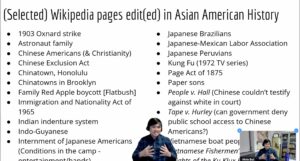
Professor Bui, who teaches Asian American history classes at BC, described how he fosters his students’ interests in AAPI history each semester through a Wikipedia assignment.
“What I do with a student is we look for a secondary source or peer-reviewed journal articles that they will read, annotate, and suggest what they learned from those articles that they can use to edit Wikipedia pages,” Bui explained.
Professor Bui emphasized the diversity of topics his students chose to explore, including Chinatowns in Brooklyn, Martial Arts such as Kung Fu, and landmark legal cases such as People v. Hall.
“The students are a mix of [those who] are of Asian heritage, and students are not of Asian heritage,” Bui explained. “I think it’s a good mix, especially because the course is cross-listed between American studies and history.”
Beyond BC, students were introduced to the ways educators have implemented AAPI studies in their curriculum throughout NYC.
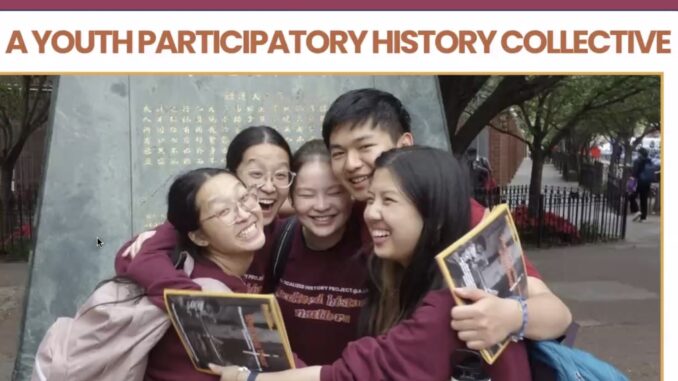
Dr. Sunderran, who will teach the AAPI Activism and Community course in Spring 2027, has been advocating for AAPI history education as director of the Localized History Project at the Asian American/Asian Research Institute at CUNY (AAARI).
“For many young people like myself who were South Asian or Southeast Asian, what did it mean to be a non-dominant Asian American within New York City and the United States?” Sunderran asked.
“As a really proud New Yorker, I was also really committed to saying what [AAPI movements] look like in our incredible city. What is Asian American studies, and what lineages do we draw from?”
A participatory history collective refers to archives curated by a particular community to tell their own stories. The Localized History Project is committed to empowering Asian youth to tell their stories and advocate for them to be told in K-12 classrooms.
Ultimately, the organizers and panelists of the AAPI studies panel wanted students to know that Asian American history is American history, and you can’t understand one without understanding the other.
“We all share society. We’re all witnessing things that are happening at the federal, state, and community level,” Dr. Pan told the Vanguard. “If we live in society and we’re curious about these things, this is why we take these classes.”
For more information about the Ethyle R. Wolfe Institute, visit @bc.wolfeinstitute on Instagram or visit their website: https://www.brooklyn.edu/wolfe/