By: Ameena Khan
Black Solidarity Day (BSD) is celebrated annually every Monday before Election Day and is hosted at Brooklyn College (BC) by the Black Solidarity Committee.
Founded in 1969 by BC Professor Carlos E. Russel, BSD is held in solidarity with the Black community and highlights the crucial role democracy plays in demanding reparations.
This year, the Black Solidarity Committee held “Arts and Activism” as the final BSD panel on the sixth floor of the Student Center for attendees to unwind, engage in art as a form of resistance to oppression, and to celebrate Black identity.
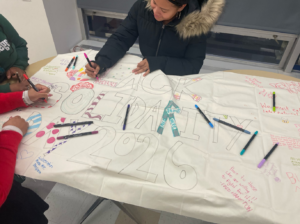
The event kept attendees engaged by having them gather around a table and decorate a banner with hollow letters spelling “Black Solidarity Day 2026.”
Some attendees filled in the hollow letters with elaborate, colorful designs and patterns. Others wrote messages such as “Liberation across the diaspora,” “‘Peace to those who are willing to fight for it! – Fred Hampton,” and “I’m Black and I’m proud.”
Ramatu, a BC senior majoring in chemistry, discussed her experience at the event and highlighted that it was her first time attending BSD.
“My friend Nyima is the vice president of the Black Solidarity Day Committee. And basically, she was just going around […] trying to promote the event, and I was there, helping her sometimes with the promotion. I just wanted to come because this was my first time ever coming to Black Solidarity Day events.”
Meanwhile, the Black Solidarity Day Committee invited audience members to the stage to share their own art forms related to activism and celebrate Black identity.
Nymia Elmore, vice president of the Black Solidarity Day Committee and a BC junior majoring in Sociology, was one of the first attendees to take the stage and read her original poem about self-expression and jewelry as a form of resistance.
“The things I wear, rings that fit perfectly on each finger that you see as accessorization that I see as my ancestors fight for emancipation.” Elmore recited to the audience.
“Where my attention lies is in your demise. My freedom of expression is my enterprise. This sounds, the beauty, the details that shine. With unity, it all aligns.”
When Elmore was asked by The Vanguard what inspired her to write her poem, she recalled her experience of wearing jewelry since middle school and the evolution of going from small to bigger, flashier jewelry as a way to honor those who came before her.
“[Jewelry] can really be seen as something very suffocating, or restricting, but I feel like it is my freedom of expression, and I feel like my ancestors fought for that expression,” Elmore told The Vanguard.
“They fought for me to do whatever I want, to wear my flashy jewelry, to make noise when I walk into a room. […] I think that it shows my persistence because it contains my ancestors legacy of being as dramatic and over the top as I want to be.”
“I really like the poems because I think that [the performers’] poetry was very beautiful,” Ramatu had expressed to The Vanguard, witnessing attendees volunteer and go up stage one by one to perform.
“I think they attest to what a lot of Black people and people of color go through in America and even just globally. I really liked the last [poem] because it was about protecting your own spaces, very much protecting all the spaces [and] this push, or, this call to people to really stand up [to] the system, like capitalism. We’re conditioned to accept the bare minimum or accept being disrespected.”
The last performance was by Fia Sanchez, the President of the Black Solidarity Day Committee and a BC senior majoring in sociology and minoring in Puerto Rican and Latin Studies.
Sanchez performed “Blackbird” on the guitar, a song released in 1968 by The Beatles as a message of solidarity during the Civil Rights Movement for Black Americans.
“Blackbird is like a Black woman,” Sanchez told The Vanguard.
Yet, Sanchez expressed to the audience that they were not a huge Beatles fan, rather a huge Beyoncé fan, and how they were inspired to cover Beyoncé’s rendition of the song, retitled as “BLACKBIIRD” for her 2024 album, “Cowboy Carter.”
“[The song] felt connected to me in that way in terms of [how] it was originally meant to show support for the civil rights movement. And then Beyoncé kind of brought it into her album in terms of highlighting black country artists and just black musicians in general.”
When The Vanguard asked Sanchez about the importance and relevance of arts and activism within BSD, they highlighted the importance of having a space for people to express themselves freely.
“Art is inherently connected to activism. You can even see all these flyers here. They all have an artistic level of design to it. […] The arts and activism [panel] was just a way to highlight that, but also, to just give a place for us to wind down the day and have free expression.”
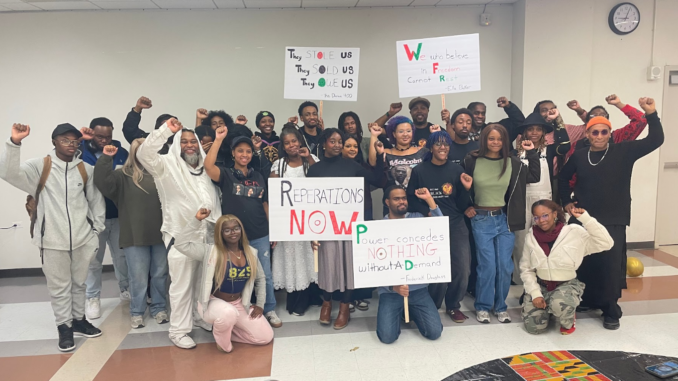
Towards the end of BSD, all students and faculty came together for a group photograph, raising signs reading significant messages such as “Reparations NOW.”
Other signs included quotes from prominent Black revolutionary activists such as Frederick Douglass stating “Power concedes NOTHING without a demand,” and other messages such as “They STOLE us, They SOLD us, They OWE us” from The Durban 400, and “We who believe in freedom cannot rest,” stated by Ella Baker.
Attendees, such as Elmore, expressed the importance of BSD being a City University of New York (CUNY) wide event, not just limited to BC. Other attendees, such as Sanchez, expressed the need for BC to excuse students and faculty from classes to attend in solidarity with BSD.
“BC needs to give us some more promotion,” Sanchez told The Vanguard.
“The students should be excused from classes. Professors should be bringing their classes here because this is important information.”
“A lot of topics we talked about involved the students in our school, and I really liked how they were like centering, not only just the faculty, but students, [and] that’s very much needed in this college,” Ramatu had reflected as the event came to a conclusion .
“We’re building a community that we are longing to have.”
Students interested in learning more about Black Solidarity Day can follow the committee on Instagram @blacksolidaritydaycommittee_bc