
By: Renae Visico
On Tuesday, May 5, the Brooklyn College (BC) Asian American & Native American Pacific Islander-Serving Institution (AANAPISI) Project (BCAP) held the third annual Tea Ceremony in the Tow Center Atrium.
The Tea Ceremony was co-hosted by the Bangladeshi Student Association (BSA), the CUNY Uzbek Society, Dream Team, Korean Culture Club (KCC), Pakistani Student Association (PSA), The Asian Pacific Islander Organization/Club Alliance (TAPIOCA), BCAP, and the Women’s Center and the Office of Student Activities Involvement & Leadership (SAIL).
In honor of May as Asian American and Pacific Islander (AAPI) Heritage Month, the annual event highlights cultures from all regions of Asia: East, West, South, Central, and the Pacific Islands.
“The point of the Tea Ceremony is to increase people’s curiosity about these art forms and cultural traditions,” BCAP Program Coordinator Jamie Chan told The Vanguard. “You get a little taste of these traditional art forms, and you get to think about how these traditions are passed on.”
The Tea Ceremony drew an influx of BC students who were curious to learn about the diverse cultures on campus, regardless of whether they were regulars at BCAP or had never interacted with Asian cultural clubs before the ceremony.
“I’m Belarusian, but I can say that I’ve learned a lot about Asian culture,” sophomore Vanessa Tseytlina shared with The Vanguard. “I just love how diverse it is, and how I got to expand my taste palate and everything. […] This will definitely factor into my conversations with my Asian friends and other Asian people I meet.”
“The turnout is a lot bigger. I think people are just getting way more acquainted with BCAP now,” said junior Alexius Petit-Frere, who is a regular at BCAP. “I really feel the energy, the performances will be amazing, and every year it gets better.”
As students entered the ceremony, they were greeted with lively 90’s cantopop music presented by Chinatown Records, an archive of DJ Yiuyiu’s inherited family record collections from China.
The performances at the Tea Ceremony, true to the organizers’ goals, represented various regions across Asia. From the Pacific Islands, a Hawaiian & Samoan duo composed of Kawena and C. Ulualofaiga “Alo” Fepulea’i To’omalatai Coleman performed their traditional music and dance inspired by the phrase “o’ou mama na,” which means “my breath is yours” in Samoan.
“We thought it was appropriate to tie [this phrase] to our performance today in the spirit of resistance,” Alo told the audience. “It’s all about taking and sharing one another’s breaths, but we continue to do the hard work. We continue to fight, just one more time.”
From East Asia, the Buryat-Mongolian ensemble Zerd performed traditional Mongolian throat singing, with some artists playing the Mongolian instrument Morin khuur, also known as a “horsehead fiddle.”
From South Asia, the BSA, represented by Vice President Shabrin Juthi and Secretary Marowa Begum, performed a contemporary Bangladeshi dance.
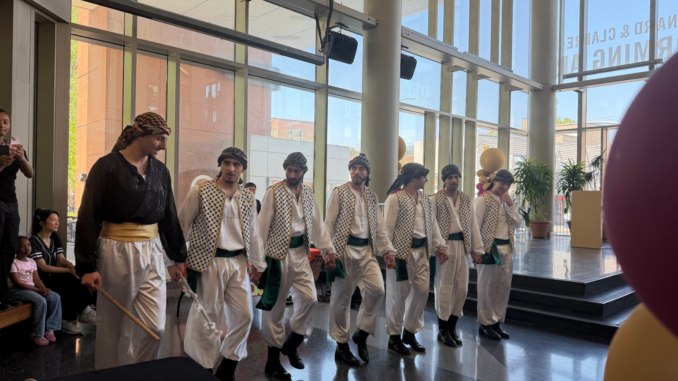
From West Asia, Palestinian dance ensemble Freedom Dabka took advantage of the spacious Tow Atrium to perform the traditional Palestinian Dabka, which many BC students enjoyed.
The student clubs that co-hosted also contributed to the diversity of Asian representation by presenting their own cultural foods, including pakora from PSA and bichak from CUNY Uzbek Society.
“We’re not all really that different because we all drink tea. We all eat stuff with our tea,” PSA treasurer Zara Kabir told The Vanguard. “Each culture has its own beautiful history and background, so it’s important to learn that history and just appreciate it.”
Of course, the Tea Ceremony could not have proceeded without addressing the elephant in the room: BCAP’s future remains uncertain, but there is a glimmer of hope.
In September 2025, the U.S. Department of Education (DOE) announced it would end funding to several Minority-Serving Institutions (MSIs) across the nation, including AANAPISIs and many other institutions that serve Asian Americans, Hispanics, and Native Americans.
Initially scheduled to end operations by July 2026, Undergraduate Student Government (USG) President-Elect Robert Echevarria announced at the ceremony that BCAP has been granted an additional extension to run until September 30.
“My USG Vice President, Illan Saji, and I envision running a USG that will restore recent federal funding cuts to Brooklyn College,” Echevarria addressed the audience.
“We need to put pressure on our NYC Council to agree to fund BCAP and all of the AANAPISI Projects across CUNY.”
Throughout the ceremony, eighty students signed a letter to be sent to NYC council speakers, campaigning to redirect funding to BCAP, using templates provided by Echevarria.
“I signed the letters and scanned the QR code [for USG’s email campaign], and I encourage every student to do the same,” said Tseytlina. “BCAP is essential to campus student life, and it needs to continue to live on as long as possible.”
This year’s Tea ceremony was a valuable celebration of Asian cultural diversity across the BC campus and a reminder that everyone, regardless of cultural identity, has their role to play in creating spaces where any culture can be appreciated.
“We all have to be there for one another, which is something that you have to actively do. You can’t be passive about it,” Sociology Club President Tyana Dixon told The Vanguard. “Even if you’re not Asian or Pacific Islander, you should still show up regardless because we’re humans at the end of the day.”
Organizers wanted students to realize the defunding of BCAP is only a reflection of what’s happening to Asian communities across the nation. It’s also important to start by appreciating and being present for local communities, including those on campus.
“One special moment at the [BCAP] office that stuck with me in particular is finding a fellow student who speaks the same dialect as me: Taishanese,” said Tea Ceremony Master of Ceremonies (MC) Natalie Wu.
“It feels endearing being able to connect with students who come from the same background as me, as well as students who come from different cultures. I truly believe that is what makes BCAP so special.”
For more information about BCAP, visit the office’s Instagram: @bcap.brooklyn